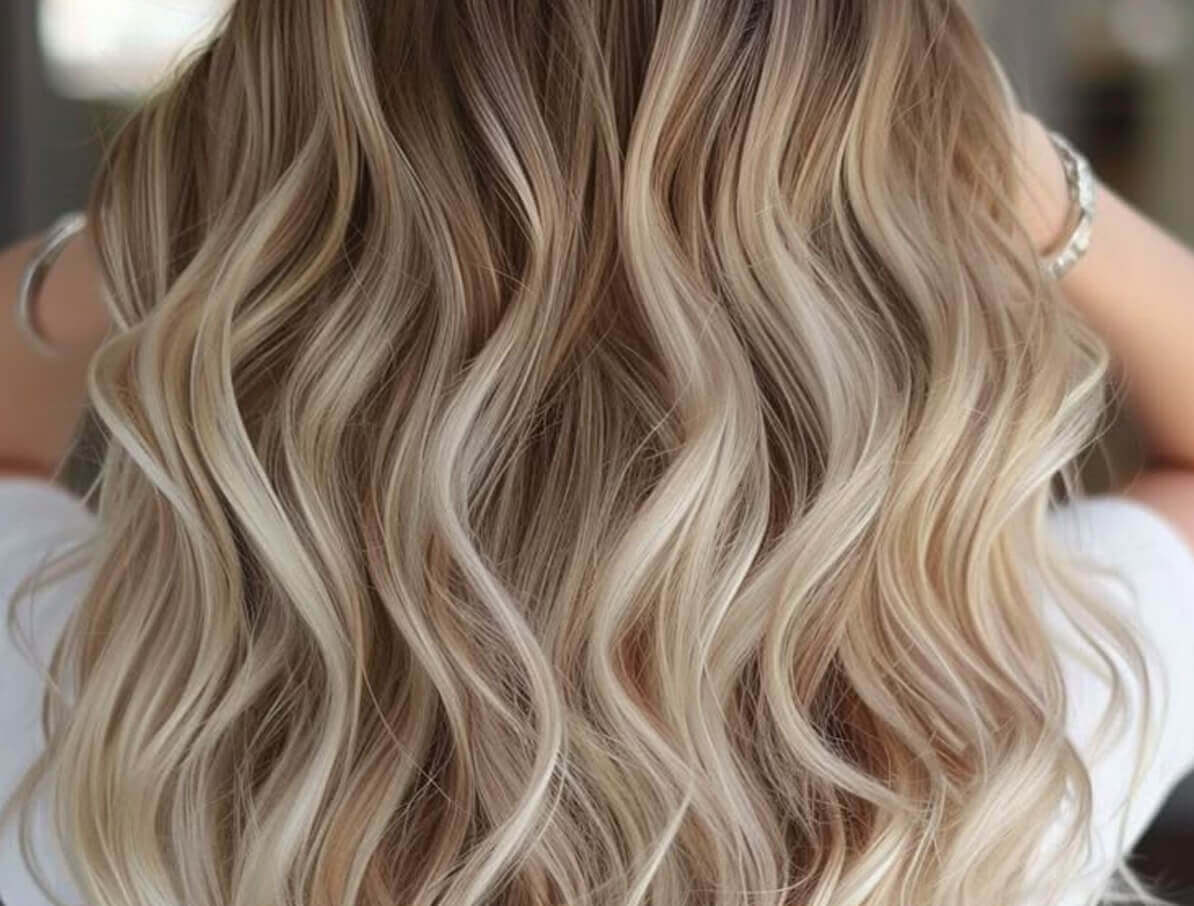
What is balayage
Balayage means colouring by hand, where the colourist paints the lightener freehand onto the surface of individual strands. There is no rigid map behind it, more a way of painting light where the sun would naturally catch your hair.
The name comes from the French balayer, meaning "to sweep", because the brush moves in light strokes. Those very strokes create the smooth transition the technique is loved for around the world.
Unlike classic highlights, the stylist does not wrap the strands in foil. The colour breathes in the open air, so the edges stay soft and your hair colour looks natural.
The word balayage turns up in print in the early 1970s. The technique is said to have started in Parisian salons around then as a gentler alternative to all-over bleaching, though that story has no hard sourcing, and today it is one of the most requested services colourists see.
How the balayage technique works
The colour blend is built as a gradient: the colour is fuller and darker near the roots and gradually lightens towards the ends. Your eye never catches on a hard line, and the hair reads as one whole.
The stylist works from roots to ends, stretching the lightener so the transition stays invisible. The closer to the ends, the denser the colour sits, and the strands take on a sun-kissed, lived-in effect.
It is an open technique without foil, so the colourist sees the result right during the work. That control makes it possible to match the tone precisely to your hair length and cut.
Simplified, the colouring runs through a few steps:
- The colourist divides the hair into sections and plans where the light will fall.
- The lightener is painted freehand from mid-length down to the ends.
- The colour develops in the open air, without foil, while the reaction is watched.
- The hair is washed, toned if needed and finished with care products.
How long the colouring takes
A full service on medium-length hair usually takes two to four hours. The duration depends on thickness, starting colour and how many tones you want.
Balayage, ombré or shatush: the difference
Balayage, ombré and shatush are often confused, since all three create a colour blend. The difference lies in where and how sharply the hair gets lighter.
Ombré is more of a horizontal transition, where the top stays dark and the bottom is noticeably lighter, with a blockier line. Balayage works finer, with vertical strokes on individual strands, so it looks more natural.
Shatush gives an even softer, gently faded effect without pronounced light strands. If you want control over every strand, balayage leaves the colourist the most freedom.
Who balayage suits
The colour blend suits almost any hair type and colour, since the amount of lightening can always be adjusted. That is one reason the technique has stayed in fashion for years.
Balayage sits beautifully on both straight and wavy hair. On curls it emphasises volume, as the light strands play across the bends of the locks.
On different hair colours the result looks different, and that is exactly its strength. On dark hair the transition is kept softer, on light hair you add more contrast.
Length matters too: on long and medium hair the play of light is more visible than on very short hair. Even so, the colouring adds volume on short cuts as well.
This technique is a great fit if you want to:
- lighten your hair without a harsh regrowth line
- keep your natural colour at the roots
- take a break from frequent colouring, as the roots grow out unnoticed
- freshen up your face with a play of light tones
Balayage for dark and light hair
On dark hair the technique gives warm caramel and hazelnut tones, and on light hair it opens a natural play of wheat and honey shades. One approach, yet a different result every time.
Balayage on dark hair is built carefully, step by step, so the structure is not damaged. A favourite variant, the caramel balayage, adds depth without harsh lightening.
On light hair a few tones of difference are enough for volume and shine. Here the colouring refreshes the natural colour rather than changing it.
Popular shades this season are cool ash, copper and chocolate. The tone is always matched to your skin and eye colour so your face looks fresher.
There is also a reverse balayage, where light strands are darkened instead for a more natural look. It is often recommended if you are growing out your own colour after frequent bleaching.
How to prepare for your appointment
It is best to arrive with clean but not over-dried hair. A few simple steps help the colour sit more evenly and last longer.
A week before your visit, do a nourishing mask so your hair is stronger before lightening. Do not colour your roots with henna the day before, as it reacts unpredictably to lightener.
Bring a photo of the result you want so the stylist understands the tone exactly. The real condition of your hair and ends the colourist will assess on the spot.
Balayage at home or with a mobile stylist
Trying balayage at home yourself is possible, but an even transition and a clean colour are hard to get without experience. Most often it is the colour blend that gives amateur work away.
Balayage at home from a ready-made kit often turns out patchy, because it is hard to stretch the lightener evenly along the whole length. The mistake then has to be fixed in the salon, which costs more than the original service.
There is a simpler solution: balayage at home, but in the hands of a professional. The stylist comes to your home with all the materials and colours your hair in your own familiar space.
That format suits parents with small children, busy people and anyone who values their time. You get a salon result at home, without travel or waiting rooms.
How much balayage costs
The price depends on the length and thickness of your hair and the complexity of the blend. At Hanna Valiullina a fine balayage starts from 130 euros and a complex balayage, shatush or ombre from 180 euros, home visit included.
Longer, thicker hair needs more product and time, so the price rises. The exact amount the stylist names after assessing your hair, with no hidden extras.
You will find the full list of services and prices on the services page. The home visit is already included within Papendrecht and the Drechtsteden.
Hair care after colouring
After colouring your hair needs hydration and colour protection so the tones stay clean as long as possible. Care here is almost as important as the technique itself.
For the first few days, wash your hair a little less often so the pigment settles. Use a sulphate-free shampoo and products for coloured hair.
Light strands sometimes turn yellow, so a purple-pigment toning product once a week helps. Heat protection before the dryer and curling iron spares dry ends.
Once a month, do a deep nourishing mask, especially for lightened ends. Healthy, hydrated hair holds the tone better.
The big advantage of this colouring is that the roots grow out softly. You can refresh the colour less often, and your hair stays looking cared for longer.
Balayage by Hanna Valiullina
Hanna Valiullina does balayage as a home visit, so you get a salon colour in your own bathroom. The stylist comes to you at a time that suits you.
Every colour starts with choosing a tone that fits your hair colour, skin type and lifestyle. We pick a technique that needs minimal upkeep and grows out nicely.
The mobile service covers Papendrecht and the surrounding towns of the Drechtsteden. The stylist brings all materials and care products along.
Want a natural colour transition without a trip to the salon? Book at hannavaliullina.nl and the stylist will come to your home.
Frequently asked questions about balayage
What is the difference between balayage and highlights?
Highlights are set in foils in even sections along the whole length, while balayage is painted freehand mostly near the ends. That makes the colour transition softer and more natural.
Does balayage damage your hair?
Balayage is gentler than an all-over colour because the lightener only touches selected strands rather than every hair. The roots usually stay untouched, so the hair structure suffers less.
How often do you need to refresh balayage?
Thanks to the soft transition at the roots you can refresh the colour every three to four months. That is less often than a classic single-tone colour.
Can you do balayage on dark hair?
Yes, the technique works beautifully on dark hair. The colourist chooses warm caramel or hazelnut tones and blends them gradually to keep the hair looking healthy.
How long does a balayage appointment take?
Depending on the length and thickness of your hair, a session takes two to four hours. Longer hair and stronger lightening need more time.
Can you do balayage on coloured hair?
Yes, the technique often refreshes already coloured hair, but the colourist checks its condition first. If your hair was previously bleached or dyed with henna, an extra consultation is needed.
Which is better: balayage or ombré?
Balayage gives a more natural, softer transition because it is painted with point strokes on individual strands. Ombré is more noticeable along the line, so the choice depends on how much contrast you want.
Key takeaways
- Balayage is an open technique of hand colouring with a smooth colour transition.
- It suits dark, light, straight and wavy hair.
- The roots grow out unnoticed, so you refresh the colour less often.
- Balayage at home is safest in the hands of a stylist who comes to you.
- After colouring your hair needs hydration and shade protection.