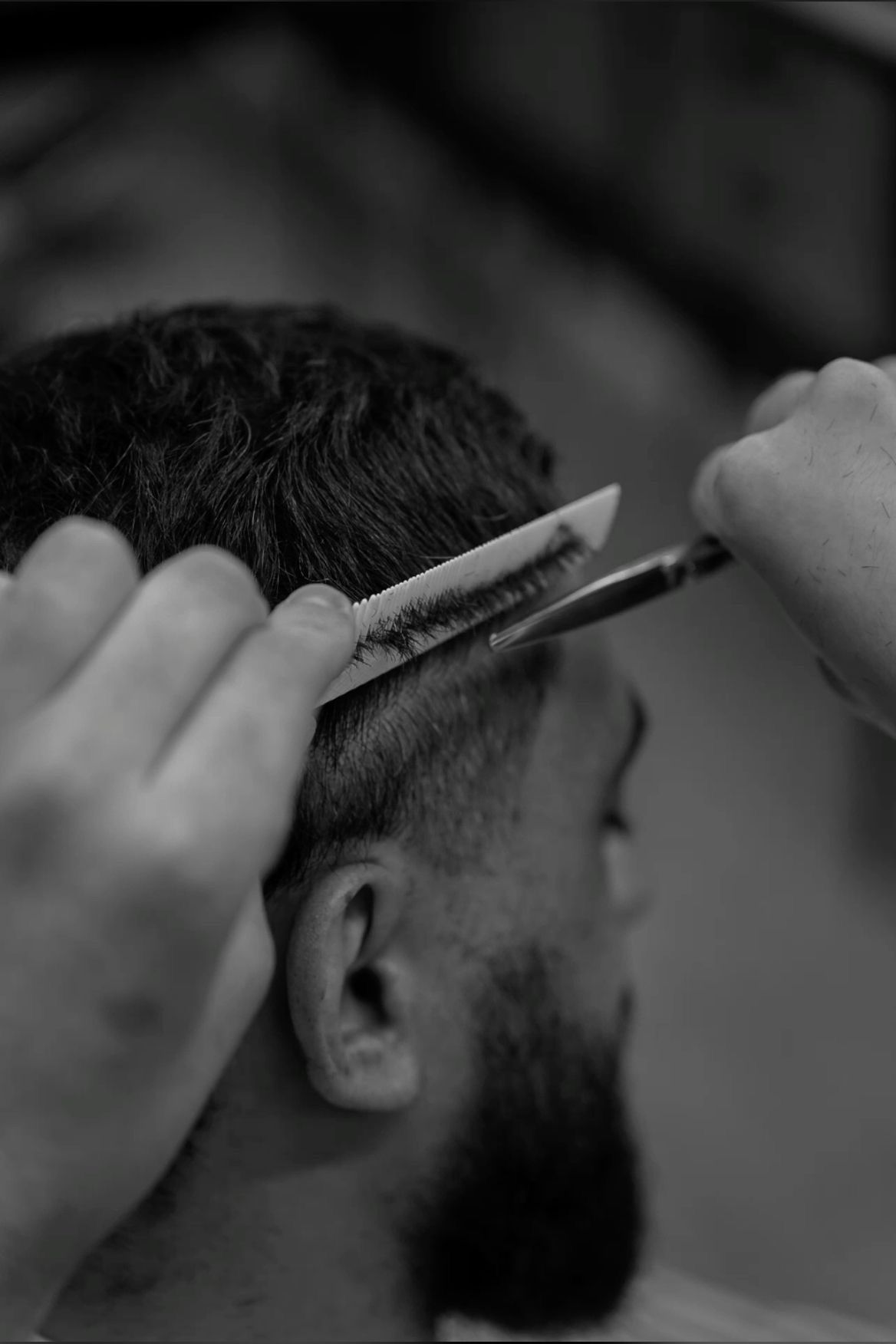
How often should you go to the hairdresser
Short hair every four to six weeks, mid length every eight to ten, long every ten to twelve. That is the answer most people can work with.
There is an assumption underneath it that rarely gets said out loud. Those intervals are about the shape of your cut, not about the health of your hair.
Anyone growing their hair out, or wearing a cut that grows out gracefully, can leave it for months. Anyone wearing a sharp bob will see within six weeks that the line no longer sits right.
So the real question is not what is normal, but how fast your particular cut loses its shape. The rest of this article is about judging that yourself.
Why one centimetre a month decides everything
Scalp hair grows an average of about 0.35 millimetres a day, which works out at roughly a centimetre a month. Almost every cutting interval in the trade follows from that single number.
On a pixie that centimetre is a third of your length and shows immediately. On hair down to your waist it is under five percent and nobody notices.
Growth rate varies between people and cannot be steered with a product. What you can steer is how much length you lose along the way to breakage.
The growth cycle in brief
Every follicle runs through three phases. Roughly eighty five to ninety percent of your hairs are in the growing phase, which lasts two to six years.
Then comes a short transition of two to three weeks and a resting phase of about three months, holding five to ten percent of your hairs. At the end of it the hair sheds and the follicle starts again.
Losing fifty to a hundred hairs a day is therefore normal. That is not hair loss, it is bookkeeping.
Where the six to eight weeks came from
Honestly: from the trade, not from research. I could find no dermatological guideline stating that you must cut every six to eight weeks.
What does exist is arithmetic. Six to eight weeks equals one and a half to two centimetres of growth, which is roughly where an average cut noticeably loses its shape.
Hairdressers adopted that interval because it holds for most cuts. It is a rule of thumb with a physiological rationale, not a medical instruction.
That distinction is more than pedantry. Treat the rule of thumb as a prescription and you cut more often than you need to, paying for it in length.
Short cuts and the pixie
Short hair runs the tightest schedule and there is little room to negotiate. Expect four to six weeks.
The reason sits in the transitions. A pixie or a short crop leans on the relationship between its layers, and a centimetre of growth shifts that relationship visibly.
With a tightly worked neckline it happens faster still. Three weeks in you can already see the line softening.
Stretch the schedule too far and the cut can no longer be tidied, only rebuilt. That costs more length than timely maintenance.
Mid length hair and layers
Mid length hair with layers sits in the middle: eight to ten weeks. The layers matter more than the length.
Short layers around the face grow out of their purpose fastest. They drop and lose exactly the movement they were cut for.
Long, soft layers tolerate growth far better. Those can often sit for three months without anyone noticing.
A bob is the exception in this category. The hard line at the bottom makes every centimetre visible, so it follows the short hair schedule instead.
Long hair and split ends
On long hair cutting stops being about shape and becomes about the ends. Ten to twelve weeks is normal.
The tip of a long hair is years old and has survived thousands of washes, brushes and drying sessions. Cosmetic scientists point to friction and torsion during grooming and styling as the cause of split ends.
A split hair cannot be repaired. Products can glue the split shut for a while, but the fibre itself stays torn and keeps tearing upward.
Cutting is therefore the only real fix, and on long hair it is the cheapest one. Half a centimetre now saves five later.
The dermatology association also lists a hundred brush strokes a day as a cause of split ends. That piece of old beauty advice can safely be dropped.
Curly hair keeps its own rhythm
Curls hide growth better than straight hair, which stretches the interval. Twelve weeks is no exception there.
What curly hair does need sooner is attention to the ends. The bend of a curl is where the fibre takes the most punishment.
I prefer to cut curls dry, curl by curl, because that shows where the length actually lands. Cut wet, a curl springs back exactly as far as it seemed longer.
The signal that it is time sits in the volume. Curly hair going triangular at the bottom carries too much weight below and too little shape.
Cutting while growing your hair out
Yes, you still need to cut, and no, it will not grow faster. Those two things get muddled constantly.
The dermatology association is direct about it: hair grows below the skin and scissors never reach that level, so cutting more often speeds up nothing. What regular cutting does is remove hair that would otherwise split.
Trimming the ends two or three times a year is usually enough while growing out. Ask for half a centimetre rather than a full one.
Say clearly that you are growing it out. A stylist who knows that builds the shape differently and keeps length where it can be kept.
Coloured hair and regrowth
Colour and cutting rarely run on the same schedule, and that is fine. They maintain different things.
With an all over colour the regrowth is usually redone every six to eight weeks, since one and a half to two centimetres of roots are visible by then. With balayage or babylights three to four months is often workable.
The dermatology association actually advises stretching the time between colour touch ups in winter to eight to ten weeks or longer. Dry air and chemistry together is a heavy combination.
Do not stack chemical services either. The advice is one service at a time with two weeks in between.
There is more on timing colour maintenance in the article about hiding regrowth.
Men and children
For men the neckline sets the schedule, not the top. A tight fade needs attention every three to four weeks.
Wear it longer on top with softer sides and you can stretch to eight or ten weeks. That halves the number of appointments.
With children the fringe is usually the trigger. It grows into their eyes well before anything else about the cut goes wrong.
For children a cut at home often works better than a salon. No waiting room, no strange noises, and the chair stands in their own kitchen.
The signs that it is time
Let your hair tell you rather than your diary. Four signals are more reliable than any schedule.
- Styling takes longer than it did a month ago for the same result.
- Your hair separates at the shoulders instead of falling.
- The ends feel drier than the lengths, even right after a mask.
- You see white dots or frayed tips when you hold a section up to the light.
That last signal is the most concrete. Twist a section around your finger and look at the hairs that stick out.
If you are unsure, it is usually not yet necessary. Being unsure about a pixie, on the other hand, almost always means you are two weeks late.
What you do between appointments
The time between two appointments decides how much has to come off. There is more to gain there than in the frequency itself.
Wet hair is fragile, so detangle with a wide tooth comb and start at the ends. Work upward rather than down.
Limit heat and use a low or medium setting. The dermatology association keeps flat irons to dry hair and no more than every other day.
Wear your hair loose or loosely tied. Sustained tension damages the follicles along the hairline, and that damage eventually becomes permanent.
A weekly mask keeps the ends supple and postpones the cut. There is more on that under hair care.
What a haircut costs
With Hanna Valiullina a women's cut starts at twenty five euros and a men's cut is twenty five euros. A children's cut starts at fifteen euros.
Trimming the ends is thirty euros and a wash with a trim is thirty five euros. Root colour starts at fifty euros.
Work out what your schedule costs per year before you object to the price per visit. Six appointments at twenty five euros are cheaper than four at fifty.
The full list is on the services page.
A haircut without leaving the house
The most underrated reason schedules slip is travel time. An appointment at home removes that reason.
I work in Papendrecht and the surrounding towns, evenings included. You need a chair without armrests, a socket, a tap and your own clean towel.
The rest travels with me: scissors, clippers, combs, clips, dryer and covers. There is no call out fee on top of the rate.
To book, or to talk through which interval suits your cut, get in touch.
Frequently asked questions about haircut frequency
How often should you get a haircut?
A short cut needs attention every four to six weeks, mid length hair every eight to ten, and long hair every ten to twelve. Those intervals come from arithmetic rather than research: scalp hair grows about one centimetre a month, and the shorter the cut, the sooner that centimetre disturbs the shape.
Does cutting your hair more often make it grow faster?
No. The American Academy of Dermatology calls this a popular but false myth, because hair growth happens below the skin where scissors cannot reach. What regular cutting does do is remove the hair that would otherwise split.
How often should I cut my hair if I am growing it out?
Two or three times a year is enough, taking only the ends. You lose less length that way than by leaving splitting ends until a much bigger cut is needed.
How often does a man go to the barber on average?
With a short cut and a tight neckline it is often every three to four weeks, because half to a full centimetre already shows. Anyone wearing it longer can comfortably stretch to eight or ten weeks.
How many hairs is it normal to lose in a day?
Fifty to a hundred a day is normal according to the NHS, and you usually do not notice. It looks alarming on a brush, but it is simply the end of a growth cycle.
How often does coloured hair need touching up?
With an all over colour the regrowth is usually redone every six to eight weeks, since one and a half to two centimetres at the roots become visible. With balayage or babylights three to four months is often fine, because the colour does not start at the roots.
How do I know it is time for a haircut?
Watch the styling rather than the calendar. If it takes more effort than it did a month ago for the same result, or if your hair splits apart at the shoulders instead of falling, the shape has grown out.
What does a haircut at home cost?
With Hanna Valiullina a women's cut starts at twenty five euros and a men's cut is twenty five euros. Trimming the ends is thirty euros and a children's cut starts at fifteen euros, all including the visit to your home.
The essentials
Short hair every four to six weeks, mid length every eight to ten, long every ten to twelve. The shorter the cut, the more visible that one centimetre of monthly growth.
Cutting does not speed up growth, but it stops split ends that would cost you length. While growing out, trimming the ends two or three times a year is enough.
Trust the signals rather than the calendar. When styling takes more effort than last month, the shape has grown out.