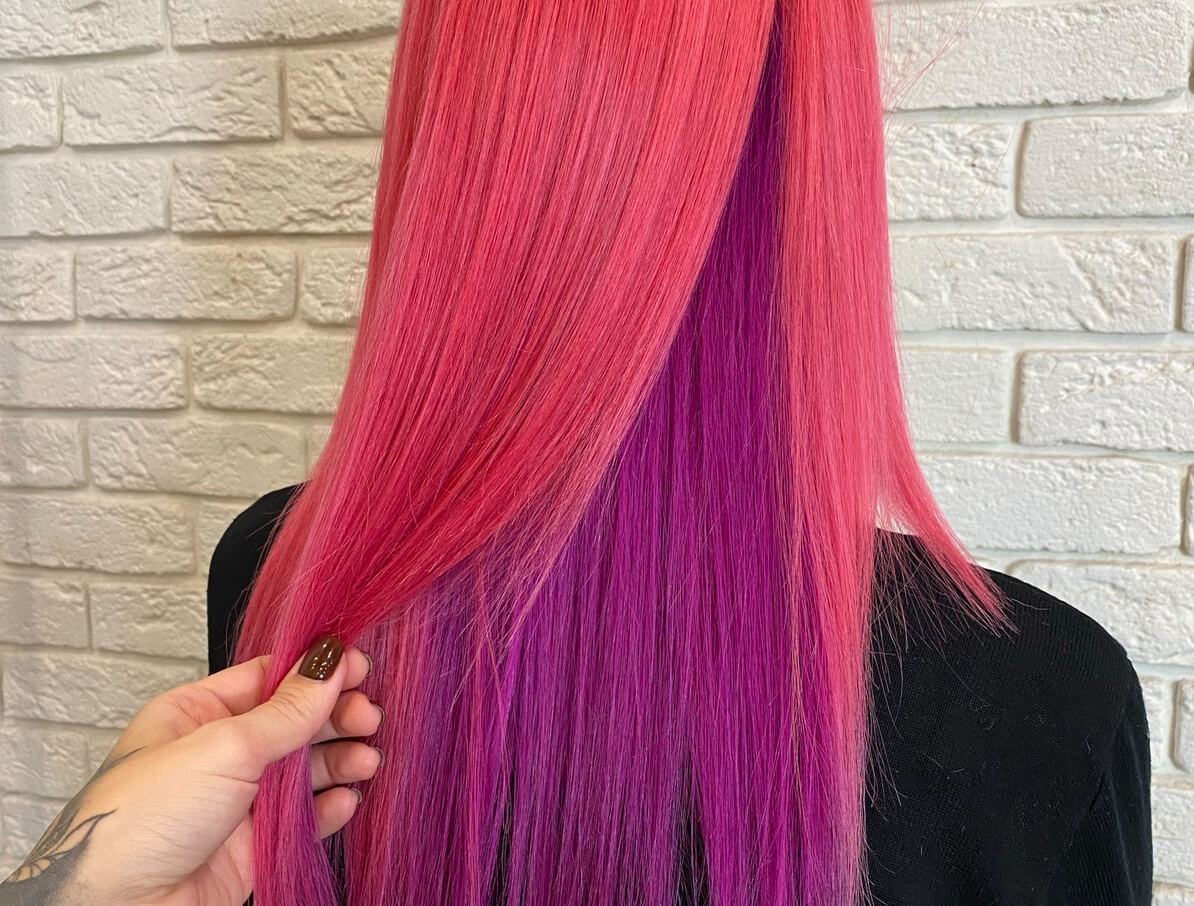
What happens when you colour hair
Colouring hair changes your shade by adding pigment, breaking it down, or doing both at once. Everything that follows, from shine to regrowth, comes out of that single intervention in the hair shaft.
In a permanent colour, hydrogen peroxide opens the outer cuticle layer of the hair. The dye moves inside and forms molecules too large to rinse back out.
That explains why colour lasts longer than a rinse and why your hair can feel drier afterwards. During the processing time the hair was literally open.
The craft is not in the application. It sits in judging how much your hair can take and which result is still realistic.
Doing it yourself or with a stylist
Refreshing the same shade or going one level darker can work out at home, but anything lighter, covering or corrective belongs with a professional. The difference shows up in what happens when it goes wrong.
A box from the chemist contains one fixed ratio meant for average hair. Yours is rarely average, certainly not if it was previously coloured, bleached or lightened by the sun.
That produces the classic home result: dark ends, a bright band along the roots and a green or orange undertone nobody asked for. Correcting the wrong colour starts at two hundred euros here and usually takes more than one session.
A stylist mixes per head, not per box. She adjusts the strength of the developer to your length, your roots and the porous spots along the way.
Which hair colour suits you
The shade that works best usually sits within two levels of your own hair colour and follows your skin undertone. The further you move from your natural colour, the more upkeep you buy.
Cool skin with pink or blue undertones sits comfortably with ash blonde, chocolate and cool brown. Warm complexions with golden or olive undertones come alive in honey, caramel and copper.
Age matters, though not the way most people assume. Grey does not make you look older; a flat, overly dark colour without depth does, because it removes every shadow from the face.
When choosing a shade, a stylist weighs up:
- your natural hair colour and how much grey it holds
- the undertone of your skin and the colour of your eyes
- previous colour work, henna or bleach along the lengths
- how much maintenance realistically fits your schedule
- the condition of the ends, since they absorb colour differently
Bring a photo of the result you have in mind. Just be honest with yourself: a photo shows the destination, not the number of sessions it took.
Permanent and semi-permanent colour
There are roughly three types of hair colour, and the difference lies in how deep the pigment travels. That choice decides how long your new shade stays and how much your hair has to endure.
Semi-permanent colour
A semi-permanent colour deposits pigment on and just under the surface layer, with no developer involved. It fades after six to eight washes, which makes it ideal for testing whether a shade suits you.
Demi-permanent colour
Demi-permanent works with a low concentration of peroxide and holds for around twenty washes. It cannot lift, but it evens out tone beautifully and puts shine back into dull lengths.
Permanent colour
Permanent colour is the only route to full grey coverage and to a result lighter than your starting shade. It grows out rather than washing out, so you get visible regrowth.
Preparation: allergy test and scalp
Good preparation comes down to two things: testing for an allergy and leaving your scalp alone. Neither takes effort, and together they prevent the nastiest surprises.
Allergic reactions to hair dye are rare but can be severe, and they appear even in people who coloured for years without trouble. That is why a patch test belongs behind your ear or in the crook of your elbow forty eight hours in advance, exactly as the instructions say.
Skip washing for one or two days beforehand. The natural oils form a thin protective film on the scalp that reduces stinging, and colour actually takes more evenly on unwashed hair.
It also helps if you:
- have no dry shampoo or styling wax left in the hair
- wear an old shirt that is allowed to catch a stain
- mention any recent perm or keratin treatment
- say whether you ever used henna or box dye yourself
That last point is not a formality. Henna and certain metallic salts react unpredictably with bleach, and you find out only when it is too late.
How a colour appointment goes
A professional colour follows a fixed order, and that order is exactly why the result turns out even. Here is what happens during an appointment at your home.
- The stylist assesses your hair, determines the level and discusses what is realistically achievable.
- Your hair is divided into four sections from the middle parting and secured with clips.
- A thin layer of barrier cream goes along the hairline, ears and neck to prevent staining.
- Your own towel goes over your shoulders, she works in gloves and your clothes are covered.
- The colour is mixed fresh with the developer that suits your hair, not a standard ratio.
- Using a brush, the colour goes on the roots first in thin lines, since scalp warmth speeds up processing there.
- About ten minutes later and more roughly, the lengths and ends follow so everything finishes together.
- The colour is left to develop, usually thirty to forty five minutes, with checks along the way.
- At the basin the dye is rinsed until the water runs clear, followed by shampoo and conditioner or a mask.
Those ten minutes between roots and lengths are not a detail. Skip them and your roots lift lighter than the rest, giving you the hot roots look so common in home colouring.
Regrowth and covering grey hair
Hair grows roughly a centimetre a month, so regrowth becomes visible after four to six weeks with a solid colour. A technique with a soft transition pushes that moment much further away.
During a touch-up the colour goes only on the new growth, with minimal overlap at most. Recolouring the full length every time stacks pigment on pigment and ends in dull, dark ends.
If you want to cover grey, the percentage decides the approach. Below fifty per cent a standard permanent colour is usually enough; above that, pre-pigmenting often becomes necessary since grey hair has no pigment left to build on.
Many clients choose a different route: not erasing the grey but lifting it with fine strands. The regrowth then disappears into the transition instead of sitting as a hard line along your parting.
Going lighter, bleaching and balayage
Hair colour can lift your hair two to three levels at most; anything beyond that requires bleach. That is a fundamentally different treatment, because pigment gets removed rather than added.
Lightening dark hair inevitably exposes warm undertones, first red, then orange, then yellow. A colourist moves through those stages deliberately and neutralises them afterwards with a toner.
Anyone who has worked with red or henna should expect several sessions. That pigment sits stubbornly in the shaft and will not leave in a single afternoon.
If you want to go lighter without the sharp regrowth line, gradient techniques beat a full colour. Think highlights, balayage or airtouch, where the roots keep your own shade.
How often you can colour your hair
A full permanent colour every six to eight weeks is sustainable for most hair types. Root touch-ups can happen more often because you are only colouring new, untreated hair.
Bleaching is another matter and usually needs at least four to eight weeks of rest, longer on hair that is already damaged. Your hair has to rebuild enough lipids and protein to carry the next treatment.
There is no age at which you must stop colouring. The structure does change after menopause: hair becomes finer and more porous, so it grabs pigment faster and gentler formulas work better.
If your hair feels elastic when wet or snaps while combing, postpone the colour. A few weeks of recovery cost less than a correction on damaged hair.
Care and preventing colour fade
The first forty eight hours decide how long your colour stays beautiful, because that is when the cuticle closes around the new pigment. Washing immediately rinses part of the result straight down the drain.
After that, wash with lukewarm water and a sulphate-free shampoo for coloured hair. Wet the hair thoroughly and massage shampoo into the scalp only; the lengths get clean from what runs past them.
Use conditioner after every wash and a mask once a week, so the hair regains the lipids it lost during colouring. Blonde hair also benefits from a purple shampoo against yellow tones.
Fading comes mainly from heat, chlorine and sun. A heat protectant before the hairdryer and a leave-in with a uv filter before the beach keep your colour fresher than any expensive aftercare product.
Wash frequency counts too. Move from daily to every other day and you will see the difference in colour retention within a month.
What hair colouring costs
At Hanna Valiullina a root colour starts from fifty euros, toning from sixty euros and colouring the lengths from seventy euros. Bleaching starts at one hundred and twenty euros and balayage at one hundred and thirty.
All amounts are from-prices, since the volume of product depends on your length and thickness. The home visit across Papendrecht and the Drechtsteden is already included.
You will find the full treatment list on the services page. If anything is unclear, the stylist names the amount before a single tube is mixed.
Hair colouring at your home by Hanna Valiullina
Hanna Valiullina comes to you and colours your hair in your own bathroom, with professional products and everything needed in her bag. No travelling, no waiting room, no shared basin.
Every appointment opens with a short consultation about your hair history and the result you want. What follows is honest advice, even when that means your target shade needs several sessions.
The service runs in Papendrecht and the surrounding towns of the Drechtsteden, with evenings and Saturdays when the working week gets in the way. Clients are helped fluently in Ukrainian and Russian, and in simple Dutch or English.
Ready for a new hair colour without the hassle? Book through the contact page and the stylist will come to you.
Frequently asked questions about hair colouring
What is the best way to colour your hair?
The best approach is a colour that matches your starting shade and the condition of your hair, applied by someone who can judge both. Staying at the same level or one shade darker is manageable, but as soon as you want to go lighter or cover grey completely, a stylist gives a more even and safer result.
What should you avoid before colouring your hair?
Do not wash your hair for two days beforehand, skip styling products heavy in silicone and never leave out the allergy test. A fresh perm or keratin treatment right before a colour is also a bad idea, because your hair gets too much chemistry in a row.
How often can you colour your hair?
A full permanent colour stays safe at roughly every six to eight weeks. Touching up the regrowth can happen more often, since the dye only meets the roots instead of loading the whole length again.
Can you colour your hair while pregnant?
Colouring during pregnancy is generally considered low risk, especially from the second trimester and in a well ventilated room. Techniques where the dye barely touches the scalp, such as highlights or balayage, are the calmest choice.
How long should you wait to wash your hair after colouring?
Wait at least forty eight hours before washing so the colour molecules can settle completely. Washing sooner rinses away part of the fresh pigment and the shade fades faster.
What does hair colouring cost with a stylist?
At Hanna Valiullina a root colour starts from fifty euros and colouring the lengths from seventy euros, home visit included. The final price depends on your hair length, its thickness and how much product is needed.
Which hair colour makes you look older?
A flat, far too dark shade without depth hardens the face and emphasises lines around the eyes and mouth. A cool colour on warm undertoned skin has the same ageing effect, while a few lighter strands around the face soften everything.
Can grey hair be covered completely?
Yes, but full grey coverage needs a permanent colour with enough natural base in the mix, because grey hair has no pigment of its own left. If more than half your hair is grey, pre-pigmenting is often needed for an even result.
Key takeaways
- Colouring changes pigment inside the shaft, so the condition of your hair decides what is possible.
- Stay within two levels of your natural colour if you want low maintenance.
- Semi-permanent colour washes out, permanent colour grows out and leaves regrowth.
- Always do the allergy test and skip washing for the two days before.
- Wait forty eight hours before washing, then use a conditioner or mask.
- More than three levels lighter means bleach, and that belongs in professional hands.