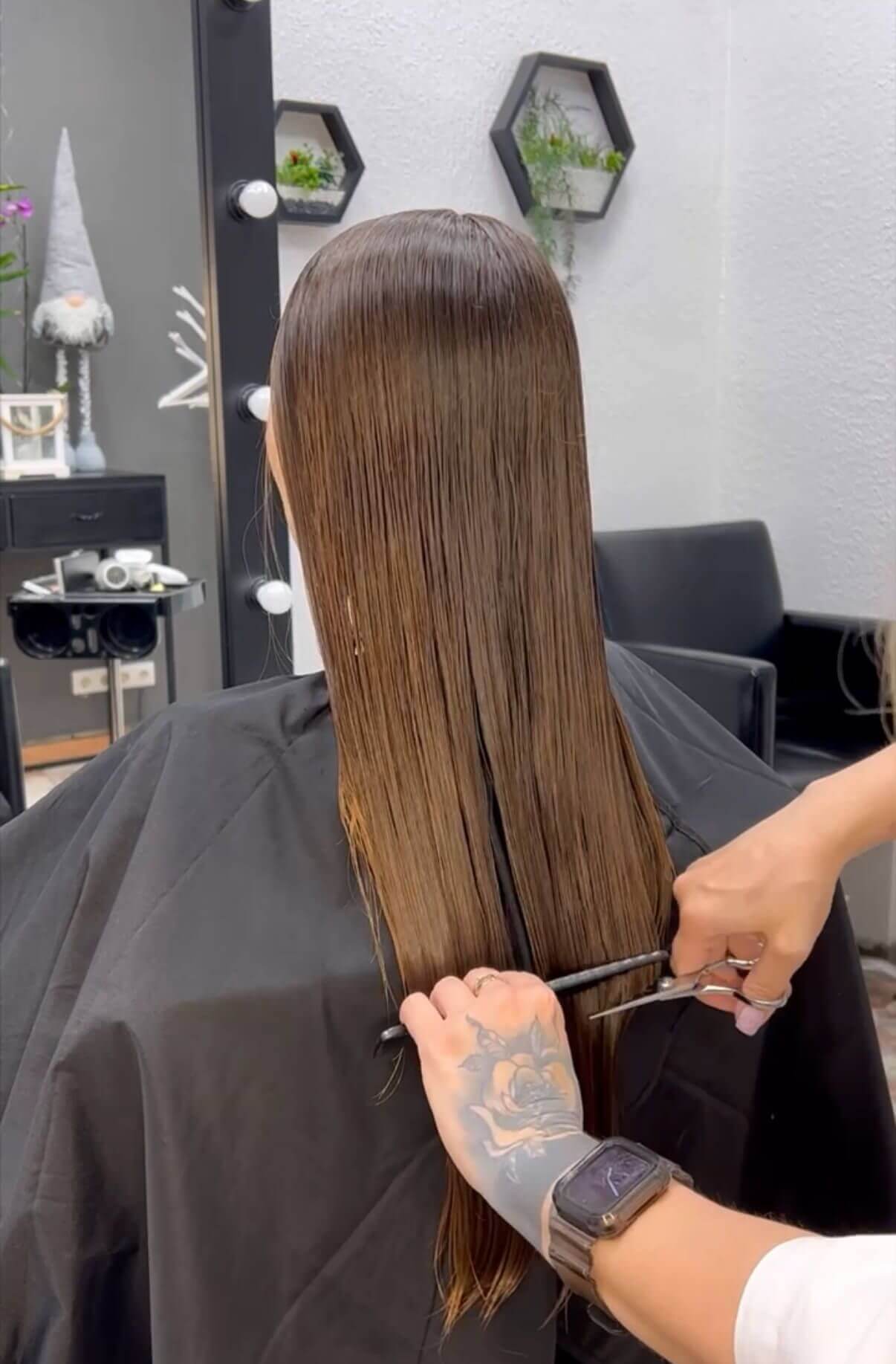
What a haircut actually does
Cutting changes nothing about how fast your hair grows and everything about how it falls. That distinction explains almost every disappointment after a haircut.
Hair grows from the follicle in your scalp, on average about one centimetre a month. Everything above the skin is dead keratin with no connection left to that rate.
That average is not a fixed law either. Measurements published in the British Journal of Dermatology came out at roughly 1.19 centimetres a month for European hair against 0.77 centimetres for African textured hair, and in one small British study the share of actively growing follicles peaked in spring.
Scissors never reach the root and cannot influence that pace. Trichologist Anabel Kingsley of the Philip Kingsley Clinic puts it plainly: anything you do to your ends will not affect growth from your roots, a trim simply makes your ends look fuller.
What is true is that freshly cut hair feels denser. You have removed the thin, worn ends, so the remaining length has a more even diameter.
That is where the real value of a cut sits. You are not replacing growth, you are preventing loss.
How often a haircut is really needed
Short answer: every four to six weeks for a short cut, every ten to twelve weeks for long hair. The familiar six to eight week rule is an average that fits almost nobody exactly.
The rhythm follows your shape, not the calendar. A sharp line loses its edge as soon as a centimetre grows in, while long layered hair keeps falling well for months.
- Short cut or sharp bob: every four to six weeks, otherwise the line disappears.
- Fringe: touch up every two to four weeks, since a fringe grows out of sight fastest.
- Mid length with layers: a cut every eight to ten weeks.
- Long hair you are growing out: trim the ends two or three times a year.
- Chemically treated or bleached hair: slightly more often, because the ends thin out faster.
Growing your hair out does not mean cutting less is automatically better. Leave the ends untouched for two years and you lose more length to breakage than a hairdresser would have removed in the same period.
Cutting your own hair or seeing a hairdresser
Cutting your own hair works only on a straight line at a length you can see. Everything beyond that belongs to a hairdresser, and that is geometry rather than sales talk.
You cannot see the back of your head. Working with two mirrors reverses your movements, so your hand corrects in exactly the wrong direction.
Then there is the fall of the hair. Hair does not grow perpendicular to the skull, and the angle at which you lift a section decides whether you get an even shape or uneven layers.
Hairdressers work with fixed sections, a fine comb and constant tension. They cut along the direction the hair will eventually fall, not the direction they are holding it in.
The one move that often does succeed at home: pull a ponytail straight down and take half a centimetre off. That gives a slightly rounded line and is reasonably forgiving.
Anything further, from a new shape to face framing layers, is a craft. People who try it first usually let a hairdresser remove more length than was ever necessary.
Cutting a fringe, the hardest centimetres
A fringe fails in the same way almost every time: too much hair, too wet, cut straight across in one horizontal line. It dries and pulls up visibly shorter than intended.
Wet hair stretches considerably under tension and springs back afterwards. Cut a wet fringe at eyebrow level and you end up with one halfway up your forehead.
The second mistake is the triangle. Take too much hair forward and the sides of the fringe run too far back, costing you the hair you need when you tie it up.
A hairdresser works from a narrow triangle at the crown, cuts dry and uses small vertical snips instead of a continuous line. That vertical technique softens the edge and makes the grow out far less abrupt.
A new fringe is also a commitment. Count on a touch up every two to four weeks, because nothing in your cut grows out of place faster.
Every hair type needs a different cut
The same shape falls four different ways on four hair types. A good hairdresser cuts to texture and density, not to a photograph.
Curly hair
Curls are cut dry, curl by curl, because the stretched length when wet tells you nothing about where the curl will land. A curl can dry up to a third shorter.
Layers are not a luxury here but a necessity. Without removing weight, curly hair builds a triangular shape that widens towards the bottom.
Fine hair
Fine hair benefits from a blunt, closed line that keeps the density together. Too many layers make it look thinner, exactly the opposite of what most people want.
Thick and coarse hair
Thick hair needs weight removed, but from the inside. Thinning at the surface creates frizzy pieces that stick out everywhere.
Wavy hair
Waves sit between two worlds and react strongly to length. A few centimetres too short and the wave turns into volume where you do not want it.
Cutting wet or dry
Wet cutting gives the cleanest line, dry cutting gives the most honest result. Which one you need depends on the shape.
Wet hair is smoother, heavier and easier to divide into equal sections. For a blunt cut or a bob that is exactly right, which is why a spray bottle is always within reach.
But water also makes hair elastic. Under tension a wet shaft stretches measurably, and a section pulled too tight comes back shorter than the one beside it.
Dry cutting shows you what is really happening. On curls, on heavy hair that springs up and when touching up a fringe, it is the only way to avoid taking off too much.
In practice most hairdressers combine the two. Shape it wet, control it dry.
How a haircut goes step by step
A haircut at home takes forty five minutes to an hour and follows a fixed sequence. Here is what happens in that time.
- Discussing what you want and what your hair type allows, including how much upkeep the new shape will cost you.
- Assessing dry how your hair falls, where the crown sits and where it naturally wants to go the other way.
- Washing and combing through, or only dampening with a spray bottle if the shape calls for that.
- Dividing the hair into sections and clipping them up, usually four to six.
- Setting the base length in the bottom section, after which every following section is matched to it.
- Building the shape with layers or a closed line, depending on the cut you agreed on.
- Checking for even length by bringing sections from left and right forward and comparing them.
- Blow drying and correcting dry, because only then can you see where half a centimetre is still too much.
- Finishing with styling and an explanation of how to get the same result at home.
The checking step is the one almost always skipped at home. Without a dry check a half centimetre difference stays invisible until your hair dries the next day.
Trimming ends and split ends
Split ends cannot be repaired, only cut off. Any product promising to mend them glues them together at best, until the next wash.
The outer layer of your hair, the cuticle, closes around the shaft like roof tiles. Wear that layer down with heat, brushing and sun and the core underneath frays and splits.
The annoying part is that a split does not stay put. It travels upward, and the longer you wait the more healthy length you eventually lose.
Trimming therefore costs little length if you are on time. Half a centimetre to a centimetre is enough, provided it is done with sharp shears in a clean cut.
A blunt blade or a pair of kitchen scissors does the opposite. It crushes the shaft before it cuts, and a crushed end splits again within weeks.
Layers, shape and choosing a new cut
Choosing a new cut starts with upkeep, not with the photo. The honest question is how many minutes you want to spend on your hair each morning.
Layers remove weight and add movement, but they also demand more styling. If you prefer to let your hair dry on its own, a blunt shape with low upkeep serves you better.
Face shape matters less than people claim. What does matter is where your hair holds volume and where it stays flat, and that differs per head.
A practical point few people consider: short hair needs more appointments than long hair. A short cut is cheaper per visit but more expensive per year.
Men and children haircuts
Men cuts are about transitions, children cuts are about pace. Both call for a different approach than a women cut.
For men the work sits in the sides and the neck, where clipper and scissors have to blend without a visible edge. That blend closes up within two to four weeks, which shortens the cutting rhythm.
With children the technique matters less than the circumstances. Cutting at home often works better, because a familiar room keeps a child calmer than a salon full of mirrors and noise.
A first haircut for a baby or toddler does not have to be a milestone. Tidying the pieces at the neck and above the ears is usually enough.
Care after the cut
What you do after the appointment decides how long the shape holds. Two habits make most of the difference: less heat and better combing.
Always use heat protection before a dryer or a straightener. Without it the moisture in the shaft evaporates too fast and the ends you just paid for start to break.
Comb wet hair from the bottom upward, not from the scalp down. Wet hair is at its most fragile and pulling from the top gathers every knot into the ends.
A hair mask once a week keeps the length supple. Apply it only from the chin down, since on the scalp it mostly makes hair flat.
And do not dismiss the pillowcase as a detail. Silk or satin creates less friction than cotton and noticeably reduces frizz.
Finally, do not panic at what stays behind in the comb. Both the NHS and the American Academy of Dermatology call fifty to a hundred hairs a day normal shedding, entirely unrelated to whether you have just had a cut.
What a haircut costs
With Hanna Valiullina a gentlemen cut is twenty five euro, a women cut starts at twenty five euro and a trim is thirty euro. Children start at fifteen euro and a wash plus trim is thirty five euro.
Those amounts include the home visit within the service area. There is no travel surcharge and no evening supplement.
What does move the price is the length and density of your hair. Very long or very thick hair takes more time, and that is agreed beforehand rather than settled afterwards.
Budget eight to twelve appointments a year for a short cut. Long hair with occasional trims stays at two or three, which makes the yearly cost lower than most people expect.
Haircuts at your home
Hanna Valiullina cuts hair at your home in Papendrecht and the surrounding area, with her own equipment and without you having to travel. All you need is a chair and a socket.
The advantage goes beyond convenience. Your hair is cut in the light and the setting you actually wear it in, not under salon lighting that makes everything fall differently.
A cut also combines logically with colour in the same appointment. See services for the options, or read how a colour appointment works in the article on hair colouring.
For an appointment or advice on what suits your hair type, get in touch.
Frequently asked questions about haircuts
How often should you get your hair cut?
Every four to six weeks for a short cut, every ten to twelve weeks for long hair. If you are growing your hair out, trimming the ends two or three times a year is enough to stop breakage.
Does cutting hair make it grow faster?
No. Growth happens in the follicle inside your scalp and scissors never reach it. What you do gain is length retention, because a split end cannot travel further up the shaft.
Should you cut your own hair or go to a hairdresser?
Trimming a ponytail straight across sometimes works at home, but layers, a fringe and the back of your head almost always go wrong. A hairdresser cuts along the fall of your hair and corrects while cutting, which you cannot see in a mirror.
How many centimetres does hair grow per month?
About one centimetre a month on average, so twelve to fifteen centimetres a year. The pace depends on hair type: measured values run from around 0.8 centimetres a month for African textured hair to 1.2 centimetres for European hair.
What does a haircut at home cost?
With Hanna Valiullina a gentlemen cut is twenty five euro, a women cut starts at twenty five euro and a trim is thirty euro. A wash plus trim is thirty five euro and the home visit is included.
Should hair be cut wet or dry?
Wet cutting gives the cleanest straight line and is standard for a blunt cut. Curly hair is better cut dry, because wet hair stretches and springs back shorter than intended once it dries.
How do you cut a fringe without ruining it?
Cut a fringe dry, in small vertical snips and never in one horizontal line. Use a fine comb, take less hair than you think and remove half a centimetre at a time.
What should you never do when cutting your own hair?
Never use kitchen scissors, because a blunt blade crushes the shaft instead of slicing it cleanly. Do not cut blind towards the back of your head and never remove several centimetres in one go.
The essentials
Cutting does not speed up growth, but it does stop you losing length to split ends. That is the only reason a haircut belongs in your calendar.
Let the rhythm follow your shape: four to six weeks when short, ten to twelve when long. A fringe needs attention every two to four weeks.
Cutting your own hair stays limited to a straight line you can see. For layers, a fringe or a new shape, a hairdresser returns more than the money you save.