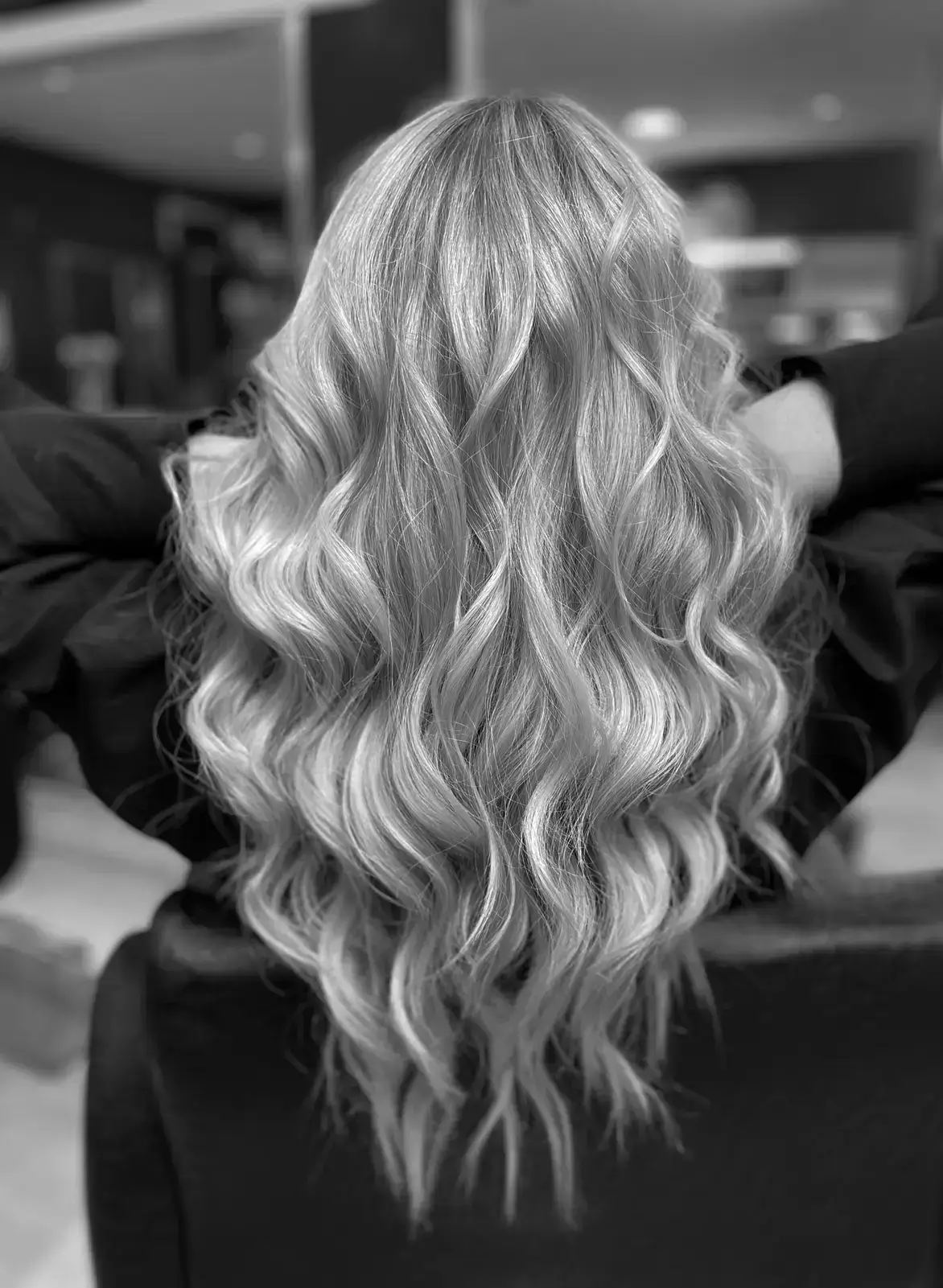
How to make curls that last
Dry hair, narrow sections, short contact time and cooling before release. Those four rules fix most failed curls.
Cooling is the most important and the most frequently skipped step. Hair takes its shape as it cools, not as it heats.
Drop a curl straight away and it stretches under its own weight while the shape is still soft. That is why it looks flat an hour later.
The rest of this article covers which method suits your hair, and the limit of heat your hair tolerates.
Why curls drop
There are four causes and all four are fixable. Usually it is not your hair refusing to cooperate.
- Your hair was not fully dry, so the iron evaporated water instead of shaping anything.
- The sections were too thick, so the inside never got warm enough.
- You released the curl before it cooled, and then it pulls itself straight under its own weight.
- Your hair was too clean and too smooth, with no grip to hold a shape.
That last point surprises people most. Curls hold better on day old hair than on freshly washed hair.
Long, heavy hair also works against you, because gravity pulls at every curl. On waist length hair a tighter curl and more hold is not a luxury.
Preparation decides the result
What you do before the iron goes on matters more than the iron itself. Three steps cover it.
Let your hair dry completely, including the roots and the inside of thick sections. Half dry hair always gives a limp curl and sometimes damage.
Apply a heat protectant to damp hair and spread it with your hands. On dry hair the product lands where it falls rather than where it is needed.
Divide your hair into sections and work from the bottom up. Four sections is enough on fine hair, six to eight on thick hair.
Take sections about two to three centimetres wide. Wider ones feel faster but give curls that are gone within the hour.
Curling with a curling iron
The curling iron gives the most predictable result and is therefore the best place to start. Barrel diameter decides curl size.
A twenty five millimetre barrel gives tight curls, thirty three millimetre a classic curl, and thirty eight or more gives waves. Choose on what you want rather than on what is in the drawer.
Wrap away from your face for an open, natural fall and towards your face for a more styled look. Alternate direction between sections if you want a less uniform result.
Hold for three to eight seconds depending on hair thickness and temperature. Holding longer does not give a tighter curl, only more damage.
Let the curl fall into your palm and keep it there until it is cold. That costs ten seconds per section and doubles how long it lasts.
Curling with a straightener
A straightener makes perfectly good curls and gives a looser, more modern fall than a curling iron. The movement is simply harder to learn.
Clamp the section near the roots, turn the iron half a rotation away from your face and glide slowly downward. Speed decides curl size: slower is tighter.
Keep the iron at the same angle throughout the glide and keep moving steadily. Stopping halfway gives a kink rather than a curl.
This method works best on mid length to long hair. On short hair there is too little length to make the turn.
The same rule applies: cool before releasing. A straightener curl is looser and drops faster if you let it fall immediately.
Curling with a dryer and round brush
This is the mildest heated method, because the temperature is lower than an iron. It also gives volume no iron delivers.
Only start once your hair is eighty percent dry, since until then the dryer is only evaporating water. Then take sections and roll them onto a round brush.
Aim the airflow down the shaft from root to tip. That lays the cuticle scales flat, and that smoothness is where the shine in a good curl comes from.
Let the section cool on the brush for a few seconds before you unwind it. A cool shot button speeds that up.
The result is a soft wave rather than a defined curl. For beach waves that is exactly right.
Curling without heat
Heatless curling is slower and it is the only method with no thermal damage. The logic behind it is simple.
Hair contains temporary hydrogen bonds that release when it gets wet and reform as it dries. Dry your hair in a shape and you set that shape without heating the fibre.
No comparative study sets this against hot tools, so this is reasoning from the damage mechanism rather than a measured outcome. What is certain is that the temperatures which damage cuticle and cortex simply do not occur here.
It is not risk free. Wrapping too tightly creates mechanical tension and breakage, which is another way to lose hair.
So work on damp rather than soaking hair. Soaking hair does not dry through in a roll and you wake up with damp, limp sections.
Wraps, rollers and braids
All three work on the same principle and give a different kind of curl. Choose on the shape you want.
Soft wraps and pin curls
A soft rod or cloth you wrap the hair around gives large, even curls. Comfortable enough to sleep in, which is usually necessary.
Rollers and velcro rollers
Rollers give root volume you cannot get from an iron. Velcro rollers are quick but tug at fine hair, so I would skip them there.
Braids
Two braids give a wave, many small braids give a defined curl. Do not braid too tightly, because sustained tension along the hairline damages the follicles.
For all three the hair must be completely dry before you unwrap. Unwrapping damp means the shape has not set.
Which temperature to use
As low as the result allows, not as high as the tool goes. More has been measured on this than people assume.
Measurements across a wide temperature range show the cortex melts and evaporates above roughly two hundred and thirty degrees, while the cuticle resists past two hundred and fifty. That sounds reassuring until you realise damage starts far earlier.
In the one dryer study I found, cracks in the cuticle were already visible at forty seven degrees, the lowest temperature tested. A second study used a flat iron at two hundred degrees across eighty four passes to simulate a year of frequent use.
More importantly, chemically treated hair changes far more than untreated hair under the same heat. Bleached or permed hair should therefore be styled below the default setting.
In practice: start around one hundred and fifty degrees on fine or treated hair and go up only if the curl will not take. The highest setting is meant for the coarsest hair that exists.
Does a heat protectant work
Yes, measurably, and less dramatically than the packaging suggests. Both halves of that sentence are true.
A 2026 study of a thermoresponsive keratin film reported protection across a range of eighty to two hundred degrees, with roughly six and a half percent more tensile strength and over thirty percent more gloss compared with unprotected heat damaged hair. That is a real gain and not a free pass.
A heat protectant lays a film on the hair surface that measurably limits the damage. It does not remove the heat.
What it does not do is make wet hair safe. Against water boiling inside the fibre, the mechanism behind bubble hair, a heat protectant is no insurance.
Apply it evenly to damp hair and let it dry completely before the iron comes near. A heat protectant on wet hair does not protect against what wet hair itself causes.
Mousse, salt spray and hairspray
Curls need grip, and that grip comes from only a few products. The rest is preference.
Mousse on damp hair gives root volume and texture for the iron. On fine hair half a pump is often plenty.
Salt spray adds roughness and therefore grip, and works best for relaxed waves. On dry, porous hair it can be drying, so dose carefully there.
Hairspray holds, but only if you use it at the right moment. A light spray per section before curling gives more hold than a cloud afterwards.
Choose a spray you can brush out. One that hardens turns your curls into a helmet and the next day into a problem.
Cooling and setting
This is the most important section in this article. Hair takes its shape as it cools, not as it heats.
Catch each curl in your hand or pin it to your head the moment it leaves the iron. Leave it there at least ten seconds, longer on thick hair.
If you have patience, pin every curl up and leave them ten minutes before brushing out. The gain in longevity beats any product.
Then break them open with your fingers or a wide tooth brush, depending on how defined you want it. Fingers keep the curl, a brush turns it into waves.
Only then spray lightly with hairspray, from about thirty centimetres away. Spraying up close makes sticky patches rather than an even film.
Curling by hair type
The same recipe does not work on every head, and that is down to the fibre. Three situations come up most often.
Fine hair holds curl poorly but needs little heat. Work at a lower temperature here, with thin sections and a little mousse for grip.
Thick, coarse hair holds curl well but asks for more contact time. Take thinner sections rather than raising the temperature, which saves damage without costing result.
Chemically treated hair is the most sensitive and should be styled coolest. On bleached hair a heatless method is often the wiser choice.
Two heat free days a week are the best measure here too. The dermatology association keeps straighteners to dry hair and no more than every other day.
If you want curls that stay
Anyone spending an hour a week on curls should consider a perm. That is arithmetic rather than a sales pitch.
A perm breaks the disulfide bonds in the keratin, sets the hair in a new shape and closes the bonds again. The curl then lives in the fibre rather than in the styling.
In practice the result lasts three to six months and softens gradually as your hair grows. Trading a daily iron for one service a season saves a great deal of heat.
With Hanna Valiullina a perm and curls service, the bio perm or biowave, starts at one hundred and fifty euros including the visit to your home. An evening style with washing, styling and curls starts at forty five euros.
How to wash such hair afterwards is covered in the article about washing hair after a perm. For advice on whether your hair is suitable, get in touch.
Frequently asked questions about curling hair
What is the best way to curl your hair?
Work on fully dry hair, take narrow sections, hold the iron for three to eight seconds and let every curl cool before you release it. That cooling is the step most often skipped and it is what separates curls that last an hour from curls that last a day.
Why do my curls drop after an hour?
Usually one of three things: your hair was not completely dry, the sections were too thick, or you touched the curl before it had cooled. Freshly washed, smooth hair also has too little grip to hold a shape.
Can you curl hair without heat?
Yes, and it is the only method that causes no thermal damage. Rollers, wraps, braids or a soft cloth set into damp hair fix the shape as your hair dries, it just takes hours instead of minutes.
What temperature should I curl at?
As low as the result allows, and never automatically on the highest setting. In the one dryer study I found, cracks in the cuticle were visible at forty seven degrees, while curling and straightening irons typically run at two hundred.
Can I curl wet hair?
Never with an iron. Water in the shaft turns to steam, expands and blows the fibre apart from within, damage dermatologists call bubble hair, documented at temperatures above one hundred and twenty five degrees.
Does a heat protectant really work?
Measurably but modestly. A 2026 study of a keratin film found roughly six and a half percent more tensile strength under thermal stress and over thirty percent more gloss, which helps without making two hundred degrees safe.
How do I get large curls instead of tight ones?
Bigger sections and a thicker barrel, then break the curl open with your fingers once it has cooled. For tighter curls take narrower sections and a thinner barrel.
What does a perm or occasion styling at home cost?
With Hanna Valiullina a perm and curls service starts at one hundred and fifty euros, and an evening style with washing, styling and curls at forty five euros. Both include the visit to your home.
The essentials
Work on fully dry hair with narrow sections and let every curl cool before releasing it. That cooling is what prevents dropped curls.
Choose the lowest temperature that works, since cracks in the cuticle have been seen at forty seven degrees and chemically treated hair suffers most. Never put an iron on wet hair.
A heat protectant helps measurably but modestly, and heatless methods avoid the problem entirely. Anyone curling daily is probably better off with a perm.