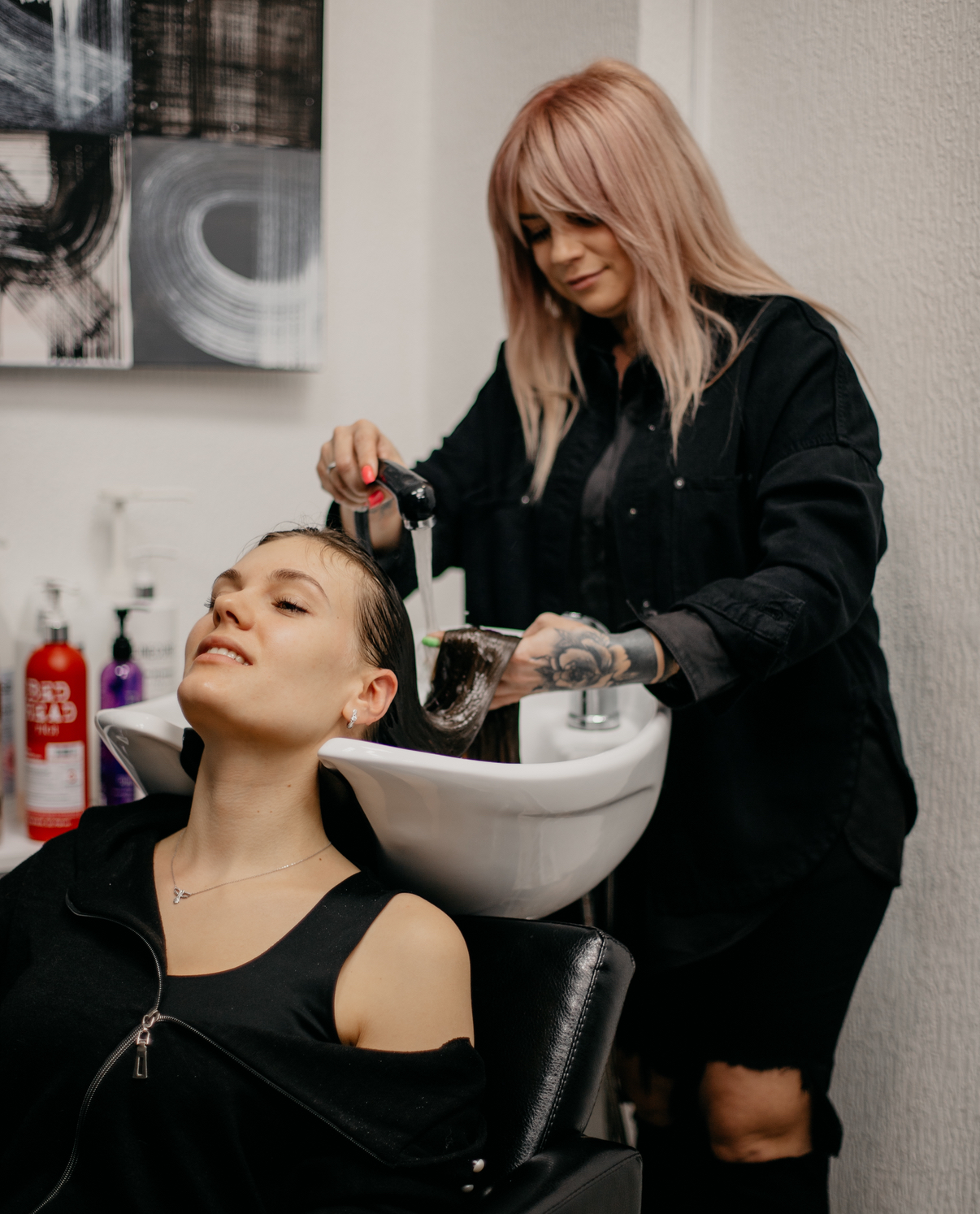
The five questions that matter
Ask about maintenance, about styling at home, about what will not work, about products, and for colour about the allergy risk. Those five remove almost every disappointment from a salon visit.
What stands out about that list is what it leaves out. Face shape, hair type codes and current trends do not appear.
That is not an accident. The questions that pay off are about the time after the appointment, and the ones that pay least are about the appointment itself.
Below is why each question works and roughly what a good answer sounds like. The one almost everybody forgets comes near the end.
A good hairdresser is recognised faster by what she asks back than by the cuts in her portfolio. Anyone who asks before she cuts is thinking about your ideal look rather than her own.
Ask about the patch test, and about what it proves
Every oxidative colour service deserves this conversation, and it goes further than a simple yes or no. The honest version is more complicated than the leaflet suggests.
The classic test is a little mixed dye behind the ear or in the crook of the elbow, read after forty eight to seventy two hours. That is the test manufacturers prescribe.
In 2019 the European Commission's scientific committee concluded that it cannot endorse this consumer test, citing potentially moderate sensitivity and applicability that has yet to be demonstrated. The committee also noted that testing before every colour raises exposure and may therefore increase the risk of sensitisation itself.
DermNet is equally direct: a negative self test does not guarantee a reaction free colour, and the test can provoke an allergy in its own right. The Dutch national institute for public health calls the test valuable in principle but inadequate and unstandardised in its present form.
The practical conclusion is not that testing is pointless, but that your history weighs more than the test. Which makes the next section more important than this one.
What the law actually requires
Colour products in Europe fall under a regulation with hard limits, and it pays to know which. It makes the conversation concrete.
Every oxidative hair colour must carry a fixed warning, opening with the line that hair colorants can cause severe allergic reactions. The same text warns explicitly about temporary black henna tattoos and states that the product is not intended for anyone under sixteen.
Concentrations are capped as well. After mixing, p-phenylenediamine may not exceed two percent calculated as free base, and hydrogen peroxide in hair products is capped at twelve percent.
What the legal warning does not contain is an obligation to test. That obligation comes from the manufacturer and from professional practice, not from the regulation.
In the United Kingdom the trade body goes further and requires a written test record, signed by the client and kept for six years. That is not a Dutch requirement, but it shows how seriously this part is taken elsewhere.
What you have to volunteer
This is not a question but an obligation, and it is the most valuable thing you bring. Without it your stylist is working blind.
- Every chemical service of the past two years: colour, bleach, perm, keratin and smoothing treatments.
- Box colour and drugstore dye, even long ago, because those pigments accumulate in the lengths.
- Henna, and black henna above all, since it demonstrably raises the allergy risk.
- Any earlier reaction to dye, however mild, and any reaction to a temporary tattoo.
- The state of your scalp: cuts, flaking, itching or recent irritation.
- Medication or a condition that affects your hair or scalp.
The black henna point is not theoretical. In a European population study 3.2 percent of people with such a tattoo in their past reacted to p-phenylenediamine, against 0.6 percent of those without.
Above all, do not hide box colour out of embarrassment. A stylist is not judging it, she is calculating with it.
Ask about your hair structure, not your hair type
Porosity decides how your hair takes colour, and it is the most useful property nobody asks about. Ask how porous your hair is and what that means for the processing time.
It is also a real, measurable property. Researchers measure porosity by gas sorption, and those measurements show that bleaching nearly triples the surface area of the fibre within the first minute.
That explains why bleached hair takes toner faster and loses it faster. It also explains why the same formula gives two different results on two heads.
You can skip the glass of water test
I found no validation anywhere for the popular test of dropping a hair into a glass of water to see whether it sinks. I could find no published study demonstrating that it is reliable.
A stylist judges porosity with her fingers and with a test strand, and that is more accurate than a glass of water. Feel free to ask whether she runs a strand test before bleaching.
The face shape question you can skip
A round face means no fringe, a long face means no extra length: those rules are in every magazine. I simply could find no dermatological or cosmetic science research testing them. As a rule of thumb it is usable, as a law of nature it is not.
That does not make it worthless, only different from how it is usually presented. It is your stylist's taste and experience, and she is entitled to both.
It only becomes a problem when it is served as a law of nature. Anyone told that something is impossible with their face is free to ask why.
The same goes for the familiar 1a to 4c hair type codes. Those were devised in the nineties by an American hairstylist, and I could find no scientific derivation for them.
A grounded classification does exist. Researchers measured curl using four objective parameters and, across more than two thousand people in twenty two countries, arrived at eight groups, deliberately without reference to ethnic origin.
Ask what the upkeep costs per year
This is the question almost everyone forgets and the most expensive one to forget. Do not ask what today costs, ask what a year costs.
An all over colour wants its regrowth redone every six to eight weeks. A balayage can run three to four months, because the colour does not start at the roots.
Just do the arithmetic at the table. Six root touch ups a year cost more than three balayages, even when the balayage is dearer each time.
Follow it straight away with how much time that upkeep takes. Money is not always the binding constraint; a Saturday morning sometimes is.
There is more on where those intervals come from in the article about how often to get a haircut.
Ask how to recreate it at home
A cut that only works in the salon chair is not a cut but a photograph. So ask what it takes to repeat it yourself.
Have the drying movement demonstrated with your own dryer and your own brush. Advice about tools you do not own is advice you cannot use.
Ask how many minutes it takes at home too. If the answer is fifteen and you have five, the cut was chosen wrongly rather than cut wrongly.
A good stylist adapts the shape to that answer. That is exactly where the craft lives.
Ask as well which styling products belong to the look you want, and how much of them to use. Giving feedback while she dries is fine too: say so if a movement does not work, because then the explanation gets adjusted.
Ask how long the appointment takes
Ask before the appointment is fixed, not once you are sitting in it. Colour work runs longer than people expect.
A cut takes forty five minutes to an hour, colour one and a half to three hours, and airtouch or a colour correction four to six hours. A correction may even be split across two appointments.
Ask explicitly whether it can be done in one go. Coming out of dark into blonde is often safer across two sessions than in one long one.
A stylist who says everything can be done in two hours is promising something your hair cannot take. That answer tells you more than a portfolio.
Ask which products and why
Ask about the reason, not the brand. A good answer names a problem, not a product line.
Three products cover most people: a heat protectant, something that gives grip and something that holds. Anything beyond that should be explained.
Ask what you can leave on the shelf as well. A stylist who talks you out of something is selling you advice rather than bottles.
On coloured hair the shampoo question is fair, though the truth is more nuanced than the marketing. Colour mainly washes out through the washing itself, so watch the acidity and the conditioning system rather than the words sulfate free.
Ask what will not work
This question separates stylists more sharply than any other. Ask where the limit of your hair sits.
A good answer is specific: not in one session, not without giving up length, or not while the previous colour is still in there. A bad answer is that anything is possible.
Because it is not. Hair that has been lifted too far takes colour unevenly, and that turns up in my work more often than people think.
Ask what happens if it disappoints, too. Anyone who explains in advance what a correction looks like has thought about it.
What a photo does and does not say
Bring a photo, but say what you see in it. Three people choose the same picture for different reasons.
One is pointing at the colour, another at the length, a third at the volume. Without a word of explanation your stylist is guessing.
Bring one of what you definitely do not want as well. That sharpens things faster than three examples of what you like.
Be honest about the photo itself. Salon lighting, filters and extensions show colours that do not exist on your hair.
Questions for a new stylist
A first appointment is less about technique and more about whether you mean the same thing. Three questions are enough.
- What do you do most often, and what do you turn down?
- How does a first appointment run with you, and how long do you allow for the consultation?
- What happens if the result disappoints?
Do not open with the biggest change if it is colour. A toner or a root touch up is a fine introduction and costs little if it does not click.
Watch above all whether she asks follow up questions. A stylist reaching for the scissors after three sentences has not heard you.
What your stylist should ask you
The conversation runs both ways, and her questions say just as much. Four of them should never be missing.
She should ask how much time you spend on your hair in the morning, because that steers the cut more than any photo. She should ask what annoys you about your current cut, since that steers better than what you like.
She should ask about your chemical history before any colour reaches the table. And she should ask when you want to come back, so the cut is built around that interval.
If those questions do not come, raise them yourself. You get a better appointment out of it, and you learn immediately how well you are being heard.
With me that conversation takes five to ten minutes at your own kitchen table, in fluent Ukrainian or Russian and in simple Dutch or English. To book or to talk it through first, get in touch.
Frequently asked questions about the salon consultation
Which questions should I always ask my hairdresser?
Five cover most of it: how much maintenance does this need per year, how do I recreate it at home, what will not work on my hair, which products do I genuinely need, and for colour work what we do about the allergy risk. The rest follows from the answers.
Do I need a patch test before my hair is coloured?
European cosmetics law does not require one; the test is a manufacturer instruction and professional practice. The European Commission's own scientific committee declined to endorse the consumer test in 2019, partly because repeated testing can itself raise the risk of sensitisation.
How common is an allergic reaction to hair dye?
In a European population study 0.8 percent of participants reacted to p-phenylenediamine, and in 0.1 percent that reaction was clinically traceable to hair colouring. In a Dutch cohort of almost seventy one thousand people, 6.8 percent of dye users reported a skin reaction at some point, over three quarters of them mild.
Is it true that your haircut should suit your face shape?
I could find no scientific support for that. It is craft experience rather than a measurement. That does not make it worthless: an experienced stylist genuinely sees what suits you, she just cannot present it as a law of nature.
What is hair porosity and can I test it myself?
Porosity is how readily your hair takes up moisture and colour, and it is genuinely measurable in a laboratory. I found no scientific validation for the familiar test of dropping a hair in a glass of water, so do not base a treatment on it.
What should I ask a new hairdresser?
Ask what she does most often and what she turns down. A stylist who says honestly where her limits are is more reliable than one who takes on everything.
What should I tell my hairdresser about my hair?
Every chemical treatment of the past two years, home colour and henna included, plus any earlier reaction to dye or to a black henna tattoo. That information decides what can safely be done, and without it your stylist is working blind.
Which question do people forget most often?
What the maintenance costs per year. People ask the price of the appointment and discover three months later that the colour they chose wants redoing every six weeks.
The essentials
Ask about upkeep per year, about styling at home and about what will not work. Those three prevent most of the regret.
For colour your own history weighs more than the patch test, since the European scientific committee will not endorse the consumer test. So tell your stylist everything about previous colour, box dye, henna and earlier reactions.
Rules about face shape and hair type codes are trade conventions for which I could find no evidence. Treat them as the opinion of an experienced professional, not as a measurement.