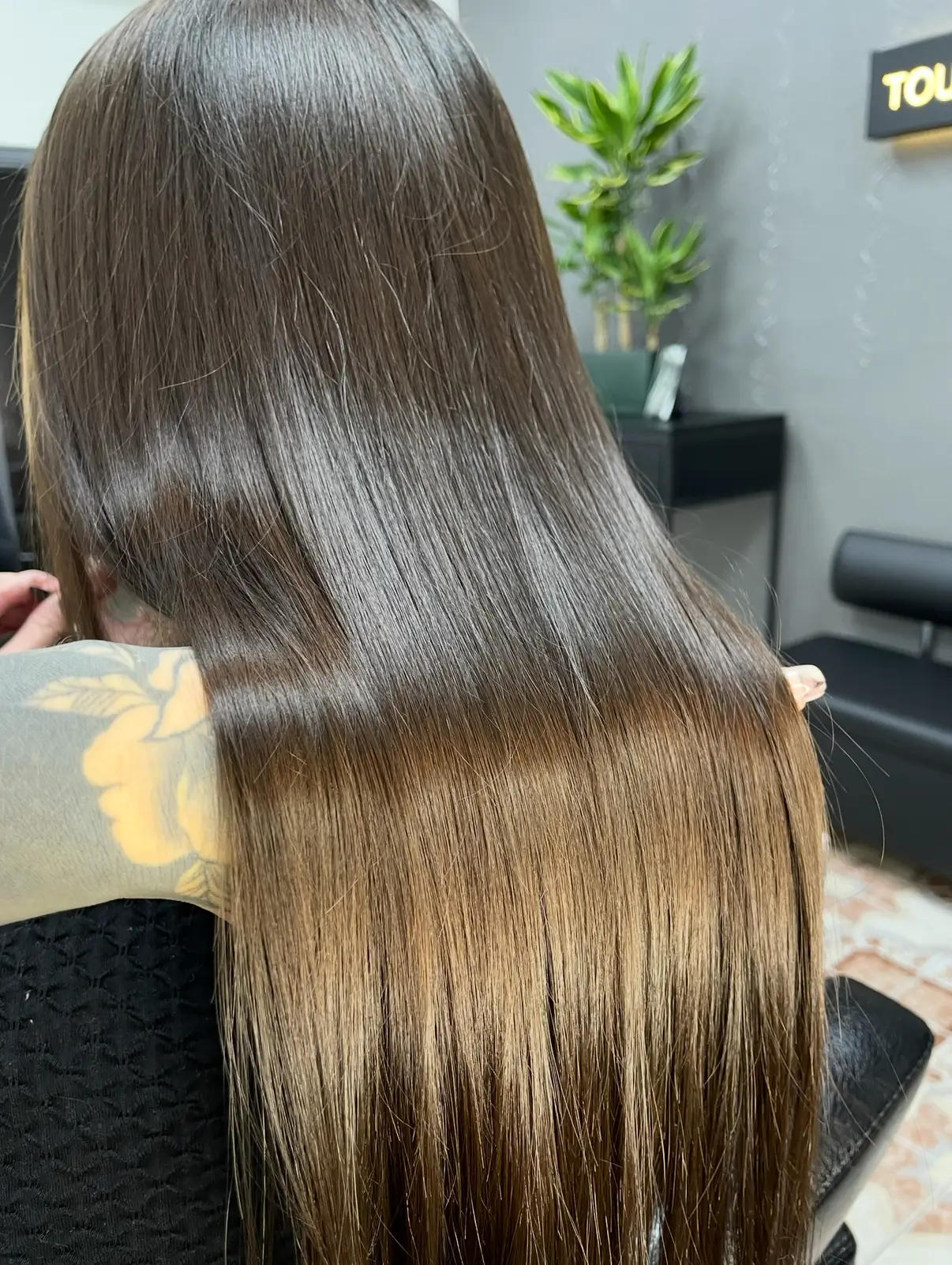
How to bring shine back to your hair
Smooth the surface of your hair and stop damaging it. That is the whole answer, and the rest of this article only explains how.
Shine is not a substance you apply but an optical phenomenon. Light reflects specularly off a flat surface and scatters off a rough one.
Products promising shine therefore work from the outside rather than from within. They even out what has become uneven.
So the only strategy that genuinely works is double: add smoothness and remove damage. The second half is free and delivers more.
What shine is, physically
Hair shine is measured with instruments rather than by eye. And what those instruments measure is very concrete.
Research into hair gloss shows it depends on the smoothness and regular layering of the cuticle scales. Surface roughness decides how much light reflects back specularly.
Instruments split that light into specular and diffuse components using polarisation. The colour reading from the instrument tracked expert judgement closely in that work: directly for colour depth and inversely for shine, because darker hair was rated shinier.
The practical conclusion sounds almost banal. Hair lying flat with its scales down shines, and windblown hair does not.
Why hair loses its shine
The causes accumulate and none of them is sudden. The tip of a long hair has years behind it.
- Chemistry: colour, bleach, perms and smoothing lift and deplete the cuticle.
- Heat: dryers, straighteners and curling irons change the cuticle at even moderate temperatures.
- Ultraviolet: sun breaks down protein and shifts colour.
- Mechanics: combing, friction against clothes and pillows, tight styles.
- Water: daily washing, hard water, chlorine and sea salt.
Those factors do not add up, they multiply. Bleached hair straightened daily ages faster than the sum of either alone.
So start by subtracting. Removing one daily factor is usually more visible than adding another product.
The cuticle and the lipid layer that does not return
Every cuticle scale carries a lipid film about a nanometre thick. Chemically it is 18-methyleicosanoic acid, and it makes hair smooth, water repellent and glossy.
How much it matters shows in wetting measurements. On untreated hair a water droplet sits on top at a contact angle of nearly ninety six degrees, and on hair without the layer it collapses immediately.
The literature names the loss of that film as the primary reason hair loses lustre and texture. That film also reduces friction between hairs, so without it your hair tangles as well.
The most important and least pleasant point: that film does not restore itself. Researchers working on it grafted a synthetic version onto the fibre precisely because the natural one does not come back.
So when a label promises repair, read it as replacing the function. That is no less useful, it simply has a different name.
Colour, bleach and lost shine
Colour and shine compete, and it helps to know that in advance. Every oxidative service takes something off the surface.
The alkaline system of a permanent colour strips the protective lipid layer, raises wettability and friction, and damages the cuticle scales so the cortex becomes exposed. Bleaching goes further: it breaks disulfide bonds and makes the cuticle markedly more porous.
That is where the vicious circle starts. Porous hair loses colour faster, so it gets coloured more often, and each colour adds porosity.
What does help is an acidic step immediately after the service. Research shows an acidic product during the rinse lowers cuticle permeability and speeds recovery from mild damage.
In my work that acidic finish is part of the treatment rather than an upsell. There is more on the process in the article about hair colouring.
Sun and heat
Sun and styling tools damage in different ways, and both cost shine. It is useful to separate them.
Research identifies UVB as the major cause of protein loss and UVA as the cause of colour change. Degradation runs through the rupture of disulfide bonds, with cysteic acid rising at the surface.
Heat starts doing harm earlier than people assume. In the one dryer study I found, cracks in the cuticle were visible at forty seven degrees, the lowest temperature tested, while straighteners typically run at two hundred.
The key rule is simple: never apply an iron to wet or damp hair. Water in the shaft turns to steam, expands and blows the fibre apart from within, a phenomenon called bubble hair.
For shine there is one more detail that costs almost nothing. Aim the airflow down the shaft from root to tip, so the scales lie flat rather than standing up.
Water, limescale and dullness
Hard water leaves deposits. Whether it also weakens your hair is less settled than the advice usually suggests.
Microscopy showed markedly more calcium and magnesium after thirty days on hair washed in hard water than on hair washed in distilled water. The surface looked rougher, and that is exactly what eats shine.
On strength the findings diverge. A small 2013 study found no difference in tensile strength or elasticity, while later work concluded that hard water lowers it.
For shine the optical part is what counts anyway. A chelating shampoo once a month removes the deposit and returns the reflection.
More often is unnecessary, because such shampoos are drying. Once a month is not a compromise but a sufficient dose.
Washing and pH
How you wash does more for shine than what you wash with. And the first is free.
An alkaline pH raises the negative surface charge of the fibre and the friction between hairs, leading to lifted scales, breakage and frizz. In a study of one hundred and twenty three shampoos only about thirty eight percent had a pH of 5.5 or lower.
So look at acidity rather than the buzzwords on the bottle. A low pH is what actually delivers smoothness.
Apply shampoo to the scalp and conditioner to the lengths. The lengths are not dirty, they are dry, and washing them separately serves no purpose.
One wash less per week shows in both colour and shine. It is the cheapest change available.
What conditioners, masks and oils do
They smooth the surface, and that is no small thing. It is simply not the same as rebuilding.
Conditioners work through positively charged compounds that bind to the negatively charged hair surface. They lie against it and lower friction, so the scales sit flatter.
With protein products only small fragments get inside. The literature names hydrolysed proteins of roughly one to ten kilodaltons as the fraction able to enter the shaft.
Oils give the fastest optical effect because they fill the surface irregularities. Dosage is everything here: a drop on the ends is enough, and more makes hair heavy and, perversely, duller.
One mask a week given real time does more than three different products rushed through. Care works through repetition, not through range.
Professional treatments for more shine
A professional treatment gives a stronger and longer effect than anything you do yourself. They also work on the surface, just more densely and for longer.
Toning and gloss
A toner adds pigment and evens the reflection at the same time, because a uniform colour reads as glossier. On bleached hair this is often the fastest route to shine.
Hair botox and express treatments
These are rich conditioning services that fill the damaged surface for a few weeks. They do not change the structure and do not straighten, but they make hair fuller in the hand and more even in the light.
Keratin treatment
This service changes the shape of the shaft itself and therefore gives the most visible shine. The effect lasts months, and the article about the keratin treatment covers it in full.
The choice depends on what exactly is dull: the colour, the surface or the shape. That is precisely what the consultation is for.
The ends and the scissors
The dullest part of your hair is the ends, and no product changes that. A split hair cannot be repaired.
Cosmetic scientists describe splitting as the result of friction and torsion during grooming and styling, and the literature deals only with prevention rather than repair. Cutting is the only way to remove what is already there.
So trimming the ends every two to three months buys more shine than an extra mask. Half a centimetre changes how your hair catches light along its whole length.
The American Academy of Dermatology adds one more detail: a hundred brush strokes a day cause split ends in themselves. That piece of old beauty advice can go.
What nutrition does and does not do
Nutrition affects the hair still to grow, not the hair already there. That boundary runs exactly along your scalp.
The hairs you see are dead, and no vitamin changes their surface retroactively. What nutrition can do is influence the quality of the next few centimetres.
In the European Union only a few nutrients may claim to contribute to the maintenance of normal hair, among them biotin, selenium and zinc. Copper may separately claim to contribute to normal hair pigmentation.
The reverse matters too: excess does harm. Chronically high selenium intake can cause hair loss and brittle nails, so more is not better.
There is more on that in the article about hair vitamins.
A weekly routine for shine
A routine works better than isolated treatments, and it is simple. This is the version I recommend most often.
- Wash two or three times a week with a low pH shampoo, applied to the scalp.
- Conditioner at every wash on lengths and ends, left on for at least a minute.
- A mask once a week in place of the conditioner, given five to ten minutes.
- Comb with a wide tooth comb, starting at the ends and working upward.
- Let hair dry to eighty percent without heat, then blow dry from root to tip.
- Two heat free days a week.
- A drop of oil on the ends after styling, no more.
- A chelating shampoo once a month if your water is hard.
The difference becomes visible after about two weeks. If nothing changes in a month, the problem is in your ends rather than in your products.
What it costs
With Hanna Valiullina an express treatment starts at fifteen euros and toning at sixty. Trimming the ends is thirty euros.
Cold botox starts at ninety euros, hot botox at one hundred and forty, and a keratin treatment at one hundred and ninety. Nanoplasty starts at two hundred and ten euros and total repair at two hundred and forty.
All those figures include the visit to your home inside the working area. The full list is on the services page.
For advice on what your hair needs, get in touch. Often trimming the ends and adjusting the routine turns out to be enough.
Frequently asked questions about hair shine
How do you restore shine to your hair?
Smooth the surface of the fibre and stop damaging it: conditioner at every wash, a mask once a week, less heat and drying from root to tip. Shine is reflected light, so anything that flattens the cuticle brings it back.
Why does hair lose its shine?
Mainly through cuticle damage and the loss of the thin lipid film on top of it. Once the scales lift, light scatters instead of reflecting specularly, and the hair reads as dull.
Can damaged hair be repaired?
Not structurally, and honest researchers say so: the lipid layer on the cuticle does not grow back once it is gone. Care takes over its function by smoothing the surface, and that is what returns the shine.
Which works better for shine, a mask or an oil?
A mask works deeper, an oil works faster. A mask with conditioning agents evens the surface for several washes, while a drop of oil on the ends gives an immediate optical effect.
Does a cold rinse add shine?
I could not find support for that in the literature. Hair has no muscle with which to pull its scales shut, so treat it as a pleasant habit rather than a method.
Why does hair go dull after colouring?
The alkaline system of a permanent colour strips the protective lipid layer and lifts the cuticle scales, which raises friction. That is why an acidic step straight after the service is worthwhile.
Does hard water affect shine?
It does, because calcium and magnesium are left on the shaft and that dulls the hair. Whether it also weakens the fibre is unclear, since the studies disagree; for the dullness, a chelating shampoo once a month fixes it.
What does a shine treatment cost?
With Hanna Valiullina an express treatment starts at fifteen euros, cold botox at ninety and hot botox at one hundred and forty. A keratin treatment starts at one hundred and ninety euros and toning at sixty.
The essentials
Shine is reflected light, so everything turns on the smoothness of the hair surface. The lipid layer providing that smoothness does not grow back, and care takes over its function.
Subtracting delivers more than adding: less heat, fewer washes, less UV. An acidic step after colouring and drying from root to tip cost nothing.
Split ends cannot be repaired by any product, so cutting does more than an extra mask. Professional treatments work, but they too work on the surface rather than inside it.