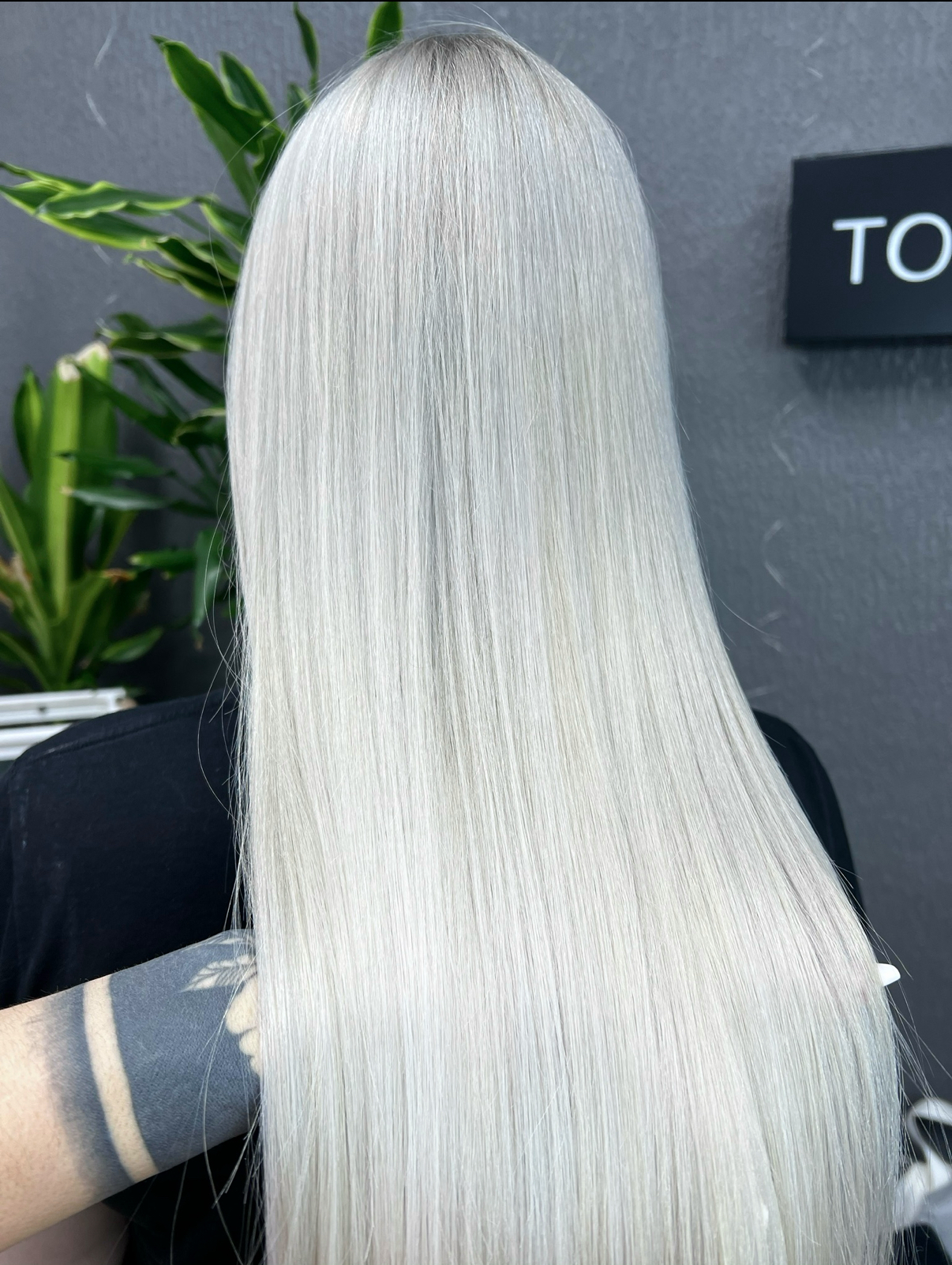
How long to wait before washing after colouring
Forty eight to seventy two hours is the usual rule, and that rule comes from the trade rather than from research. That is more honest than what you normally read.
I could find no published study relating colour retention to the time before the first wash. The American Academy of Dermatology gives no waiting period at all on its colouring and perming page.
What does exist is a mechanism that makes it plausible. And there is one measure that demonstrably works, except it happens in the salon chair rather than in your shower.
Waiting costs you nothing, so go ahead: wait at least forty eight hours, and stretch to seventy two if you can. Just know that the gain sits somewhere other than where you are looking for it.
Your hair type and its structure decide how much it matters. Porous or bleached hair lets colour go faster than thick, untreated hair, however long you wait.
Where the forty eight hours came from
The reasoning is that the colour still has to develop and the cuticle still has to close. The first is not true and the second has never been measured.
The colour reaction is driven by the alkalising agent and the hydrogen peroxide, and both are removed at the rinse. Without oxidant, the formation of colour molecules stops.
That the cuticle needs forty eight hours to close I found nowhere supported. It sounds logical and it has never been shown.
So why do I still recommend it? Because every wash costs colour, and a wash you skip is a wash that costs none.
The rule holds, then, but for a simpler reason than the story attached to it. Less washing is less fading, whatever day it is.
How permanent hair colour works
Three things happen at once, which explains why colouring is both effective and demanding. Without all three there is no lasting colour.
An alkalising agent, usually ammonia or a substitute, swells the fibre and opens the cuticle. The whole process runs at a pH of roughly eight to ten.
Hydrogen peroxide simultaneously breaks down your own melanin, making room for the new colour. That is why permanent colour can also lighten and a toner cannot.
Meanwhile dye precursors such as p-phenylenediamine react with couplers into large coloured molecules. Those end up trapped in the cortex and are too big to rinse out easily.
That is precisely the point: the colour is locked in the moment it forms. What happens afterwards is not development but wear.
The acidic finish that does matter
The best supported measure is an acidic product straight after the rinse. And it is the exact opposite of waiting.
Research into damage from dyeing and perming shows an acidic product at the moment of rinsing lowers cuticle permeability and speeds recovery from mild damage. So it works immediately, not in two days.
That is also why a good stylist does not finish the service with water alone. The acidic aftercare belongs to the colour service rather than to the retail shelf.
At home the equivalent is a low pH conditioner at every wash. Same logic, weaker dose.
So if you had to choose between two days of waiting and a proper acidic finish, choose the second. Fortunately you do not have to, because they do not conflict.
The first wash step by step
The first wash sets how the colour holds over the coming weeks. Four things are worth doing.
- Rinse with water alone for a while first, so loose pigment leaves before shampoo arrives.
- Use little shampoo and only on the scalp, because the lengths are not dirty but dry.
- Conditioner on the lengths and ends, left for at least a minute before rinsing.
- Blot with your towel rather than rubbing, because wet hair is fragile.
Do not be alarmed by coloured water at the first or second wash. That is surplus pigment on the outside, not your colour running away.
With reds and coppers the effect is strongest and lasts longest. Red pigments wash out fastest in practice.
With a colour service using highlights or babylights this matters less, because less pigment is left on the outside. The first wash is a good deal calmer then.
How often to wash after colouring
This is the part with the most evidence and the least attention. Washing is by far the biggest cause of fading.
Research into colour retention names the dye dissolving in water during washing as one of the decisive factors, alongside porosity and the surfactants themselves. The surfactants themselves add to it by dissolving structural lipids and proteins.
The mechanical part counts too. Working your hands through your hair abrades the surface, and that makes the fibre more porous.
Porous hair holds colour worse, because the dye molecules leak out more readily. Colouring makes hair more porous, so each round speeds up the next.
Washing two or three times a week is enough for most people. That single decision does more for your colour than every product in this article combined.
Dry shampoo bridges the day in between perfectly well, provided you brush it out and do not let it build up. The natural oils on your scalp protect your lengths too, and every wash takes them off.
Which shampoo, and what sulfate free actually means
Look at the pH rather than the buzzword on the bottle. That is the most useful advice the science offers here.
An alkaline pH raises the negative charge of the hair surface and the friction between hairs, producing lifted scales, breakage and frizz. In a study of one hundred and twenty three shampoos only about thirty eight percent had a pH of 5.5 or lower.
On sulfate free shampoo I could find no published analysis of effectiveness. The figures you see on packaging about longer lasting colour come from manufacturers, not from studies.
What has been shown is that conditioning polymers protect colour. In one study a hydrophobically modified cationic polymer limited how much colour washed out.
So choose on acidity and on the conditioning system in the bottle. Sulfate free can be a pleasant extra rather than the deciding factor.
Water temperature
A cold rinse does not close your cuticle. The idea is popular and I found no support for it.
Hair is dead tissue without muscles, so it cannot actively pull anything shut. The scales swell in water at any temperature.
What hot water does do is make the wash more aggressive and dry out your scalp. A lukewarm rinse is therefore both pleasant and sensible.
Just do not call it colour protection. The number of washes counts for more than their temperature.
Drying and straightening after colour
Heat costs colour and it happens faster than you would think. There is even a concrete number for it.
Research recorded a visible colour change after only ten blow drying sessions at ninety five degrees. That is under two weeks of daily use.
Bleached hair is also more vulnerable, because the protective action of melanin leaves along with the pigment. Colouring and straightening reinforce each other in the wrong direction.
The hard rule stands: never an iron on wet or damp hair. Water in the shaft turns to steam, expands and blows the fibre apart from within, damage known as bubble hair.
So let your hair dry to eighty percent without heat and then work on a low or medium setting. A heat protectant helps, if modestly.
Sun, chlorine and seawater
The sun eats your colour and that has literally been measured. Two kinds of radiation do two different things.
UVB is the major cause of protein loss and UVA the cause of colour change. UVB also breaks disulfide bonds in the fibre.
With pool water it is about copper rather than chlorine. Copper comes from algaecide and pipework, and chlorine damages hair enough that it takes up those copper traces more readily.
Wetting your hair with tap water before you get in is common advice, though I found no support for it in the cited sources. Rinse it straight afterwards either way.
With seawater it is mostly dehydration plus sun, a combination that accelerates fading. A leave-in with a UV filter is not a luxury on holiday.
Permanent, demi permanent and toner
Not every colour service asks for the same patience, because they reach different depths. The difference lies in how much oxidant is used.
A permanent colour typically works with around six percent hydrogen peroxide, a demi permanent with about two. Less oxidant means less swelling and less damage, but also a shorter life.
A toner only deposits pigment and lifts nothing. It therefore fades fastest, usually within six to twelve washes.
The more porous your hair, the faster all three release. On bleached hair that is the single most important variable.
There is more on toning in the article about the hair toner.
When to redo the regrowth
Scalp hair grows about a centimetre a month, and the whole schedule follows from that. Six to eight weeks is the usual interval on an all over colour.
The dermatology association advises stretching to eight to ten weeks or longer in winter. Dry air and chemistry together is a heavy combination.
With balayage or babylights it is different, because those techniques do not begin at the roots. Three to four months is often workable there.
Reasons to leave the regrowth longer are in the article about hiding regrowth.
Combining colour with other services
Do not stack chemistry on chemistry in the same week. Here the advice is clear and comes from dermatologists.
The dermatology association advises one service at a time, and if you want to combine a perm or a relaxer with colour, do that two weeks beforehand. So shape first, colour second.
With a keratin treatment the order is the other way round in practice: colour first, smoothing afterwards. Ask when you book, because it differs per product.
That is not excessive caution but arithmetic on load. Two alkaline processes close together do more damage than the result reveals.
What colouring at home costs
With Hanna Valiullina root colour starts at fifty euros, toning at sixty and colouring the lengths at seventy. Lifting the regrowth with toning starts at one hundred and twenty euros.
Those figures include the visit to your home inside the working area, with no call out fee. A colour service takes one and a half to three hours.
The acidic aftercare is included, because it belongs to the treatment rather than to the till. The full list is on the services page.
To book, or for advice on keeping your colour, get in touch.
Frequently asked questions about washing after colouring
How long should you wait before washing your hair after colouring?
The usual rule is forty eight to seventy two hours, and it comes from the trade rather than from research. I could find no published measurement relating colour retention to time before the first wash, so treat it as a sensible habit with a plausible story behind it.
What happens if you wash your hair the day after colouring?
Probably less than you fear, because the colour reaction stops once the product is rinsed out. Every wash costs colour, so the first one does too, but there is no evidence that this particular wash is uniquely damaging.
What should you avoid with freshly coloured hair?
In the first days avoid irons on damp hair, chlorinated water and strong sun, and do not stack a second chemical service on top. The dermatology association advises one service at a time with two weeks in between.
Which shampoo is best after colouring?
A mild, low pH shampoo, because an alkaline pH lifts the cuticle scales and raises friction. I could find no published analysis of the effectiveness of sulfate free shampoo, so watch the acidity rather than that word.
Does a cold rinse help hold the colour?
No support for that exists. Hair has no muscle with which to pull scales shut, so a lukewarm rinse is pleasant but not colour protection.
Does colour fade faster if you wash often?
Yes, and that is the best supported factor of all. Colour loss occurs predominantly because the dye dissolves in water during washing, so one wash less a week is the cheapest measure available.
How often should regrowth be redone?
With an all over colour usually every six to eight weeks, since a centimetre of roots becomes visible. In winter the dermatology association actually advises stretching to eight to ten weeks or longer.
What does colouring at home cost?
With Hanna Valiullina root colour starts at fifty euros, toning at sixty and colouring the lengths at seventy. Those figures include the visit to your home.
The essentials
The forty eight hour rule is trade convention with no published measurement behind it. Waiting costs nothing and probably helps, just for a simpler reason: one wash fewer is one wash of colour loss avoided.
What demonstrably works is an acidic finish right after rinsing, followed by a low pH shampoo. Sulfate free on the label says less than the acidity and the conditioning system.
Limit heat, sun and pool water, since ten blow dries at ninety five degrees already shift the colour visibly. And never stack two chemical services in the same week.