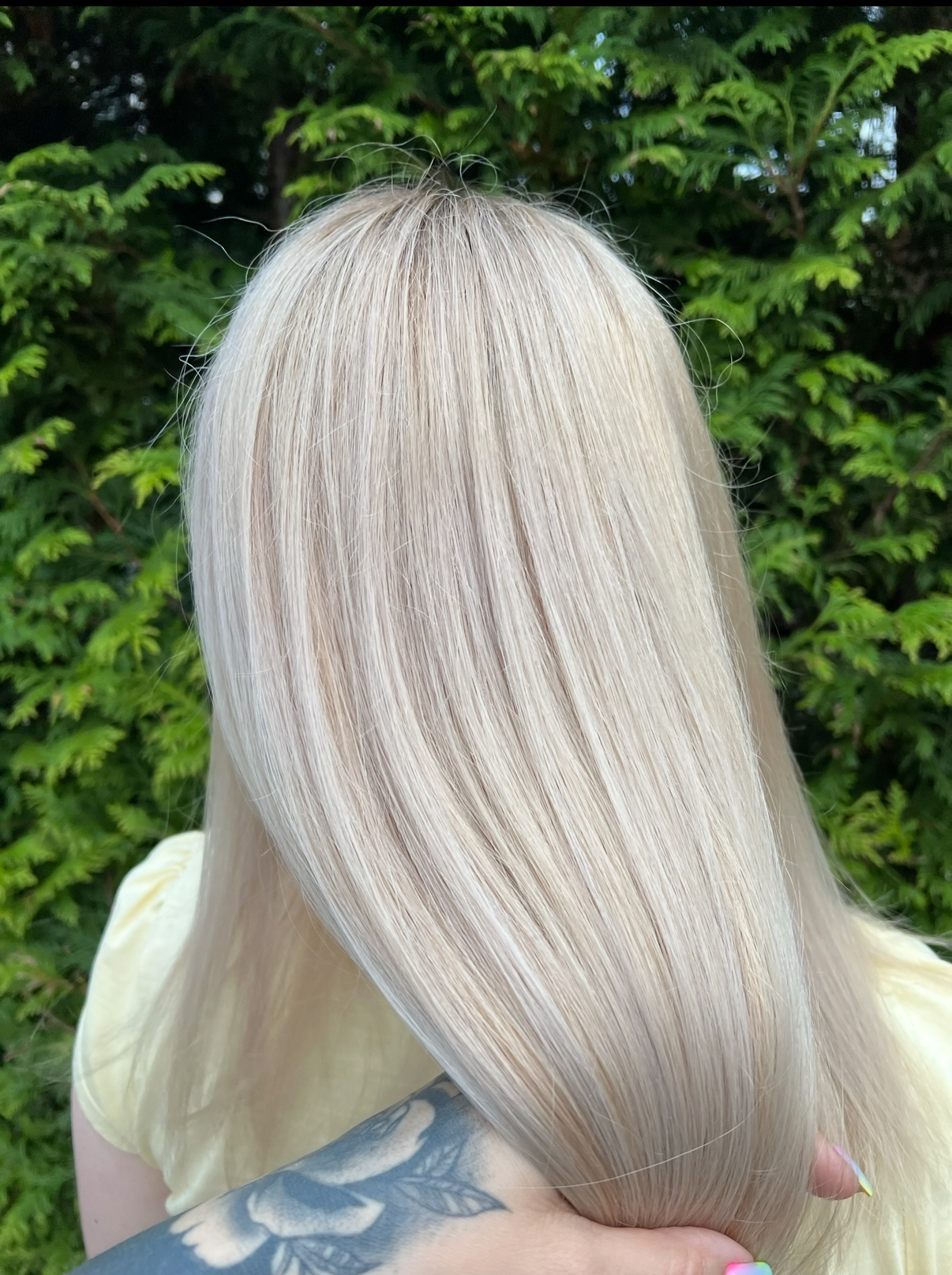
How to care for bleached hair
Wash less often, condition always, and keep sun, chlorine and heat short. Those three rules do more for blonde hair than any expensive bottle.
The reason lies in what bleaching leaves behind. The process removes not only colour but also the lipid layer that keeps your hair water repellent and glossy.
That layer does not come back. Everything you do afterwards takes over its function rather than restoring it, which is a meaningful difference from what the advertising promises.
Once you know that, you choose differently. You are no longer buying repair, you are buying replacement, and you use it more sparingly.
What bleaching does to your hair
Bleaching is oxidation, and oxidation is irreversible. The pigment in the cortex is broken down and the fibre changes with it.
Research into the physical chemistry of hair shows the process disrupts disulfide bonds and makes the cuticle more porous, leaving poorer tensile strength and more brittle hair. That is not a side effect but the mechanism itself.
Porosity is measurable, and the figures are striking. Gas sorption measurements show the surface area of the fibre nearly triples within the first minute of bleaching.
Something less visible disappears as well. Melanin protects hair against ultraviolet light, and that protection leaves with the pigment, which makes bleached hair more sensitive to sun.
How bleaching actually proceeds is covered in more depth in the article about bleaching hair.
Why blonde hair loses its shine
Shine is not a property of your hair but of its surface. Light only reflects well off something flat and regular.
Research into hair gloss points exactly there: the smoothness and regular layering of the cuticle scales decide how much light reflects back specularly. Rough hair scatters the light and reads as dull.
The layer you lose is called 18-MEA
Every cuticle scale carries a lipid film roughly a nanometre thick, known chemically as 18-methyleicosanoic acid. That film makes hair water repellent, smooth and glossy.
The difference is dramatic when measured. On untreated hair a water droplet sits on top at a contact angle of nearly ninety six degrees; on hair stripped of the layer the droplet immediately loses its shape.
Researchers state plainly that this layer does not regenerate once removed. In the laboratory they graft a synthetic version back onto the fibre, which tells you plenty about what an ordinary conditioner can achieve.
The literature names the loss of that layer as the primary reason treated hair loses lustre and texture. That film also reduces friction between hairs, which explains why bleached hair tangles faster.
Why bleached hair turns yellow or orange
Your hair contains two pigments and they do not disappear at the same speed. That difference is the whole explanation.
The brown black eumelanin breaks down faster than the red yellow pheomelanin, established as far back as 1987 in comparative work on chemical and photochemical bleaching. The warm underlying tone therefore lasts longer.
The further you lift, the more of that warm layer shows before you reach a cool result. That is why the route from dark to blonde always passes through orange and yellow.
A toner solves it by adding pigment that neutralises the unwanted tone. Bleaching decides how light your hair becomes, toning decides what colour that lightness takes.
There is more on that step in the article about the hair toner.
Purple shampoo, honestly
The colour theory holds, the evidence is thin. That is the most honest summary I can give.
Violet sits opposite yellow on the colour wheel and neutralises it optically, and blue does the same for orange. That part is uncontroversial.
I could not find published research on these shampoos themselves, though. What circulates comes from manufacturers and retailers, which is not the same as a study.
In practice the pigment sits on the outside and rinses away within a few washes. It is maintenance between treatments rather than a replacement for toning.
Overdoing it does not give whiter hair but a lilac cast. One wash in three, left on for a couple of minutes at most, is a sensible rhythm.
Washing is the biggest colour loss
Washing is the best supported cause of colour loss. It is also the most underrated factor in blonde upkeep.
Research into colour retention shows fade occurs predominantly because the dye dissolves in water during washing. Surfactant type and the porosity of your hair then govern how fast that goes.
On porous hair it happens faster, because the dye molecules leak out more easily. Bleaching makes hair porous, which closes the circle.
One wash less per week is therefore the cheapest colour protection there is. Dry shampoo bridges the day in between, although build up on the scalp brings its own problem.
And what about a cold rinse
I found nothing supporting the idea that cold water closes the cuticle and holds colour in. Hair has no muscle with which to pull scales shut.
A lukewarm rinse is pleasant and certainly not harmful. Just do not call it colour protection, because it probably is not.
The right products for blonde hair
What a conditioner does is adhere, not repair. Once you know that, you choose more precisely.
Conditioners work through positively charged compounds that bind to the negatively charged hair surface. They lay down a film that functionally replaces the lipid layer you lost.
Protein products do get something into the fibre, but only small fragments. The literature names hydrolysed proteins under ten kilodalton as the fraction able to enter the shaft.
On sulfate free shampoo I could find no published analysis of effectiveness. So look at the conditioning system in the bottle rather than the word on the label.
- A mild, low pH shampoo, used mainly on the scalp.
- A conditioner at every wash, on the lengths and ends rather than the roots.
- A mask once a week, given real time to work.
- A leave-in or light oil for the ends, especially on long bleached hair.
- Purple shampoo as maintenance, not as a substitute for toning.
Hydration and leave-in
Hydration is not a luxury on bleached hair but the core of the routine. Masks with nourishing and restorative ingredients keep the lengths supple, and a leave-in conditioner or a light spray protects the ends between washes.
More product does not give a better result, only heavier hair. On fine blonde hair too much mask shows as clearly as too little.
Bond builders and what they really do
The chemistry is real, the evidence on actual heads is thin. Both things are true at once.
The best known compound in this category is bis-aminopropyl diglycol dimaleate, and it demonstrably forms new links between the sulfur atoms in keratin. That is published chemistry, not invention.
The study describing it, however, was done in the laboratory on hair tresses, and the authors themselves write that the findings still need confirming in vivo. That is an honest caveat which rarely reaches the packaging.
What you get is an artificial bridge between two sulfur atoms rather than a restored natural bond. Useful during heavy lightening, and not a miracle.
In the chair I use them where they earn their place: during the bleaching itself, not as a separate treatment afterwards.
Sunlight and UV protection
Sun does two different things to your hair, and it helps to keep them apart. One kind of radiation eats protein, the other eats colour.
Research identifies UVB as the major cause of protein loss and UVA as the cause of colour change. The degradation runs through the rupture of disulfide bonds between the structural units.
Bleached hair is extra vulnerable here, because the pigment that normally acts as a filter has largely gone. Dark hair is demonstrably more photostable than blonde.
In practice that means a hat on a long beach day and a leave-in with a UV filter if you are outside a lot. It is not hysteria, it is the same logic as sunscreen.
Chlorine, pools and the green cast
The green tint comes from copper, not from chlorine. That misunderstanding is remarkably persistent.
Copper enters pool water through algaecide containing copper sulfate and through corroding pipework. A chemist put it neatly: chlorine does not cause the colour, but it does make it worse.
It makes it worse through damage. Chlorine attacks the fibre so that it takes up more copper ions, and porous bleached hair holds on to them hardest.
The chemist who looked into this recommends a swim cap, and afterwards a shampoo with a chelating agent such as EDTA to lift the copper out. Either way, rinse straight after swimming and condition.
Hard water and mineral build up
Hard water deposits minerals on your hair. Whether it also weakens your hair is less settled than either camp suggests.
Electron microscopy found markedly more calcium and magnesium after thirty days on hair washed in hard water than on hair washed in distilled water. The surface looked rougher too.
On strength the studies contradict each other. A small 2013 study found no difference in tensile strength or elasticity, while later work concluded that hard water lowers strength and increases breakage, and other work found the fibre stiffening.
What you can be sure of is the cosmetic part. Build up makes blonde hair dull and can push a cool toner towards warm.
A chelating shampoo once a month removes it. More often is unnecessary and dries out your lengths.
Heat, dryers and straighteners
Chemically treated hair tolerates heat worse than untreated hair. That is confirmed in measurements, and it applies to bleached hair above all.
Damage also starts lower than people assume. In the one dryer study I found, cracks in the cuticle were already visible at forty seven degrees, the lowest temperature tested.
The most important rule is a different one though: never apply an iron to wet or damp hair. Water trapped in the shaft turns to steam and blows the fibre apart from within, a picture dermatologists call bubble hair.
A heat protectant helps measurably but modestly. A 2026 study found just over six and a half percent more tensile strength under thermal stress with a keratin film, which is something, but does not make two hundred degrees safe.
The American Academy of Dermatology keeps straighteners to dry hair, on a low or medium setting and no more than every other day. For blonde hair that is not excessive caution.
Natural blonde is fragile too
Even without bleaching, blonde hair asks for more attention than dark hair. That surprises many people.
Naturally blonde hair is usually finer in cross section, so there is less material per hair to absorb damage. Fine hair also gets greasy faster at the roots and then reads as flat.
On top of that, blonde hair contains less melanin and therefore has less of its own UV filter. The same summer day costs blonde hair more than dark hair.
The approach is the same, only dosed more lightly. Conditioner on the lengths, a mask every other week, and shampoo mainly on the scalp.
What to avoid is short: do not wash daily, do not style with heat daily, do not go into the sun unprotected and do not leave the pool unrinsed. What to do is shorter still: hydrate, and leave it alone.
What blonde upkeep costs
With Hanna Valiullina toning starts at sixty euros and lifting the regrowth with toning at one hundred and twenty. Highlights without toning start at one hundred euros.
Babylights start at one hundred and sixty euros and airtouch at two hundred and twenty. Those figures include the visit to your home inside the working area.
On blonde hair expect six to twelve toning sessions a year and considerably fewer lifting sessions. Toning is the maintenance and bleaching is the intervention.
Techniques that do not start at the roots, such as babylights and balayage, stretch the interval considerably. The full list is on the services page.
For advice on which blonde suits your hair and how much upkeep it asks, get in touch.
Frequently asked questions about caring for blonde hair
What is the best care for bleached hair?
Wash less often, condition every time, and keep sun and heat short. Washing is the best supported cause of colour loss, and bleaching strips the lipid layer that normally protects your hair.
Why does bleached hair turn yellow or orange?
Bleaching breaks down the brown black eumelanin faster than the red yellow pheomelanin. That difference in resistance has been shown in laboratory work, and what remains is the warm underlying tone you see as a yellow or orange cast.
Does purple shampoo really work?
The colour theory behind it holds: violet sits opposite yellow and cancels it optically. I could not find published research on these shampoos themselves, so treat it as a maintenance product whose effect rests mainly on colour theory.
Can bleached hair be repaired?
Not literally. The protective lipid layer on the cuticle does not grow back once it is gone, so conditioners and masks take over its function rather than rebuilding it.
Why does blonde hair turn green in a swimming pool?
That comes from copper in the water, not from chlorine. Copper enters through algaecide and through pipework, and chlorine damages your hair enough that it holds those copper traces more readily.
Does sulfate free shampoo slow colour fade?
I could find no published evidence for it. What has been shown is that colour mainly washes out through the washing itself and that conditioning polymers measurably protect colour.
Does hard water damage your hair?
It deposits calcium and magnesium on the shaft, which dulls the hair and can shift a toner. Whether it also weakens the fibre is unclear, because the studies disagree: one found no difference in tensile strength, a later one concluded that hard water lowers it.
What does maintaining blonde hair cost?
With Hanna Valiullina toning starts at sixty euros and lifting the regrowth with toning at one hundred and twenty. Highlights without toning start at one hundred euros and babylights at one hundred and sixty.
The essentials
Bleaching removes the lipid layer that keeps hair smooth and glossy, and that layer does not return. Care replaces its function rather than restoring it.
Washing is the best supported cause of fading, so one wash less per week is the cheapest protection available. Sulfate free on the label says less than the conditioning system in the bottle.
Pool green comes from copper rather than chlorine, and hard water mainly dulls hair; whether it also weakens it is unclear. Limit UV and heat, and never put a straightener on wet hair.