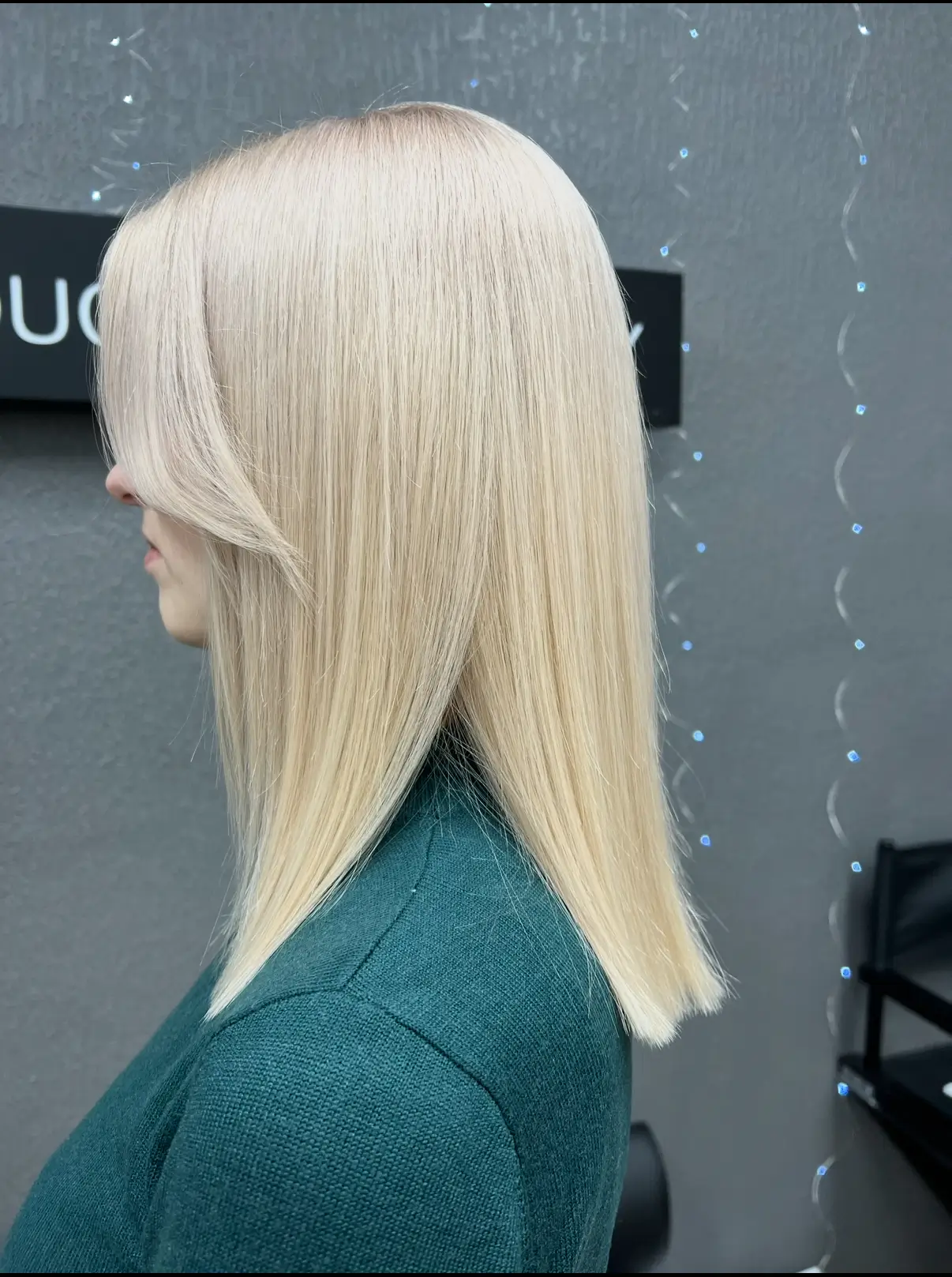
What bleaching does to your hair
Bleaching does not add colour, it removes it. The lightener breaks down the pigment in your hair, and what you see afterwards is whatever is left.
That is a fundamentally different process from colouring. A dye deposits new pigment in the shaft, while bleaching destroys the pigment already there.
Which is why bleaching is not reversible. You can lay colour over it, but the pigment removed does not come back.
And why a second step always belongs to it. Without a toner the warm underlayer released during lifting stays visible.
The chemistry behind the lightener
A lightener has three working parts: an alkaline agent, hydrogen peroxide and usually persulfate salts. Each does something different.
The alkaline agent, ammonia or monoethanolamine, brings the mixture to a pH of around nine to ten. That swells the shaft and opens the cuticle so the peroxide can reach the core.
Hydrogen peroxide does the actual work. In that alkaline environment it breaks the colour-carrying structure of melanin into colourless fragments.
The persulfate salts are accelerators rather than the lead actor. They raise the oxidising power of the system, which makes more lift possible than peroxide alone would give.
That distinction is more than theory. Persulfates are also why bleach powder as a substance can irritate skin and sometimes trigger allergic reactions, something the industry safety assessment names explicitly.
Hydrogen peroxide and the percentages
The developer decides how far you get. In practice you work with four common strengths, and the arithmetic is simple.
- 10 volume is 3 percent hydrogen peroxide and lifts almost nothing, mostly used for toning.
- 20 volume is 6 percent and lifts roughly one to two levels.
- 30 volume is 9 percent and lifts roughly two to three levels.
- 40 volume is 12 percent and lifts furthest, but does not belong on the scalp.
Those lift values are trade convention rather than measured constants. They differ per brand and per hair type, and your starting colour weighs just as heavily.
For on-scalp work twenty volume is treated as the practical ceiling. The reason is that the warmth of your head speeds the reaction up, so a higher percentage causes damage there sooner than on the lengths.
That is not excessive caution. In animal research nine percent hydrogen peroxide on skin already produced marked swelling and thinning of the epidermis, with disruption of the tissue beneath.
Levels of lift and the yellow cast
Bleaching runs in a fixed order you cannot skip. Black moves through brown to red, then orange, then yellow and only then to pale yellow.
The reason lies in the two kinds of melanin. Brown-black eumelanin breaks down faster than red-yellow pheomelanin, so as you go further the warm tones become relatively more dominant.
Where you stop decides what you are left with. Stop at orange and that is the base the toner has to work on, which means you need blue rather than violet.
Platinum therefore demands a pale yellow starting point. You rarely reach that from dark hair in one session, and anyone who tries pays for it in breakage.
What the research shows about damage
Bleaching damages hair, and that is measurable rather than a matter of opinion. Two peer-reviewed findings are worth knowing.
In a study in the Journal of Dermatology the cuticle scales stood up irregularly after treatment with persulfate and peroxide, instead of lying flat against the shaft. That is precisely what makes hair look dull and feel rough.
A second study, in the Journal of Applied Crystallography, measured porosity after bleaching at roughly three times that of untreated hair. The protein structure in the cortex and the lipid layer around it were altered as well.
Chemically it comes down to one thing: the disulfide bonds in the hair protein are oxidised into a form that cannot revert. That change is permanent.
What you often read in advertising, with precise percentages of protein or strength loss, cannot be backed by reliable research. The mechanism is settled, the exact numbers are not.
In practice you notice three things: your hair feels rougher, it absorbs water faster and it stretches further before it snaps. That last one is the signal to stop lifting.
Bond builders and what they do not prove
Bond builders are sold as the answer to bleach damage. The honest answer is that the claim sounds plausible but has not been independently confirmed.
The manufacturer describes a small molecule that penetrates the hair and relinks broken disulfide bonds, during and after lifting. That is the theory on the packaging.
What is missing is independent peer-reviewed research testing exactly that mechanism. It is not there in the accessible scientific literature.
That does not mean the product does nothing. It means you take the mechanism on the manufacturer word, and a client deserves to know that.
For protein and polymer aftercare the picture differs slightly. Independent research does show certain formulations improve the mechanical properties of chemically treated hair, though those are research formulations rather than specific products off a shelf.
Scalp and safety
The scalp is where it can genuinely go wrong. The dermatological literature contains documented cases of chemical and thermal burns after highlighting.
In a review in Cutaneous and Ocular Toxicology, Chan and Maibach described eight published cases, five of them in children. The causes were overly caustic mixtures, spillage of heated product, and heat from foil or a dryer.
The authors argued for better training of stylists and for a review of permitted concentrations. That is a serious recommendation from a professional journal, not a scare story.
In practice it means no high percentages on the scalp, and rinsing thoroughly with cool to lukewarm water afterwards. The safety assessment of persulfates explicitly assumes brief contact followed by proper rinsing.
Always mention if you have had itching or redness after a colour service before. Persulfates can cause both immediate and delayed skin reactions, and you want to know that before the product is on your head.
Bleaching at home
Bleaching at home runs into two problems that have nothing to do with technique: the strength and the distribution. Both are harder than the box suggests.
The strength is the risk to your skin. A percentage that works fine on the lengths does not belong on your scalp, and a box will not make that distinction for you.
The distribution is the risk to your colour. You cannot see the back of your head, you are working against the clock and the product keeps developing, so patches and over-lifted roots are the standard failure.
On top of that, previously treated hair behaves differently from virgin hair. Over an old colour or an earlier bleach the product takes unevenly, which is exactly how a colour correction starts.
If you do it anyway: keep off your scalp, avoid high percentages, and accept that you are moving two shades at most. And stop the moment a wet strand stretches like elastic.
How often you can bleach
There is no scientifically established safe interval. Everything you read about six or eight weeks is trade convention, not a research finding.
What does give you something to hold on to is the condition of the hair itself. A hairdresser assesses that with a simple test: stretching a wet hair between the fingers and watching how it springs back.
If it recoils cleanly, there is room. If it snaps, or stays stretched, then any further lifting is a bad idea, however many weeks have passed.
In practice a follow-up session lightens the regrowth only. Taking the lengths along again is the fastest route to breakage and gains nothing in colour terms.
Toner and purple shampoo
The toner finishes the job. It lifts nothing but deposits pigment that neutralises the yellow or orange tones.
Violet works against yellow, blue against orange. Which one you need depends on where the lifting stopped, not on what you like the look of.
Purple shampoo is the maintenance in between, not a replacement. Its violet pigments stay on the surface and rinse out over a few washes.
Do not overdo it. Too much purple shampoo leaves a lilac or dull cast, which is not damage but is exactly the tone you were not after.
More on that in the article about hair toner.
Aftercare and products
Good aftercare is mostly about doing less. Less washing, less heat, less pulling at wet hair.
Wait at least forty eight hours before the first wash and rinse with lukewarm water after that. Hot water opens the cuticle further and lets pigment escape.
A conditioner or mask is standard for bleached hair, because the shaft is more porous and dries out faster. Apply it from the chin down, not on the scalp.
On sulphate-free and purple shampoo, honesty is in order: independent research demonstrating their effectiveness does not exist. They are not harmful, but the claims are more commercial than scientific.
What demonstrably does help is limiting heat. Curling and straightening irons on a high setting do more harm to porous hair than to untreated hair, so heat protection is not a luxury here.
What bleaching costs
With Hanna Valiullina lightening the regrowth with toning starts at a hundred and twenty euro, home visit included. Highlights start at a hundred, babylights at a hundred and sixty and airtouch at two hundred and twenty.
A colour correction, putting an earlier bleach right, starts at two hundred euro. That is the amount you avoid by not taking a risk the first time.
The price moves with hair length and density, since those decide product use. On long or thick hair you hear the difference before we start.
On blonde hair, budget four to eight appointments a year, most of which are toning or regrowth only. The bleaching itself is needed far less often than people think.
Bleaching at your home
Hanna Valiullina lightens hair at your home in Papendrecht and the surrounding area, with professional products and a strength matched to your hair. You need a chair, a socket and a tap.
Every appointment starts by judging what your hair can take. Sometimes the honest answer is that a repair treatment gains you more than another shade.
If you would rather have a soft transition than a full lightening service, look at balayage, babylights or airtouch. All rates are under services.
For an appointment or advice on what is possible, get in touch.
Frequently asked questions about bleaching
What happens when hair is bleached?
An alkaline agent opens the cuticle and hydrogen peroxide then breaks the pigment inside the shaft down into colourless fragments. That is a chemical process you cannot reverse.
How many shades can you lift in one session?
It depends on the peroxide strength and on your starting colour. As a rule of thumb a higher percentage lifts further, but past two or three shades in one session the strain grows faster than the gain.
Why does bleached hair turn yellow?
Brown-black eumelanin breaks down faster than red-yellow pheomelanin, so what remains is a warm underlayer. You remove that yellow cast with a toner, not with more bleaching.
Does bleaching always damage hair?
Yes, to a greater or lesser degree. Research shows the cuticle scales lift irregularly after bleaching and porosity increases sharply, and neither repairs itself.
Can you bleach your hair at home?
You can, but the two things that go wrong at home are the strength and the distribution. Too high a percentage on the scalp causes irritation or worse, and uneven application leaves patches that only a colour correction can fix.
How often can you bleach?
There is no scientifically established safe interval; what you read everywhere is trade convention. What does count is the condition of your hair, and that is assessed again before every session.
Do bond builders really prevent damage?
Manufacturers describe a molecule that relinks broken disulfide bonds inside the hair. No independent peer-reviewed research confirming that mechanism could be found, so treat it as a manufacturer claim.
What does bleaching at home cost?
With Hanna Valiullina lightening the regrowth with toning starts at a hundred and twenty euro and a colour correction at two hundred. Highlights start at a hundred euro and babylights at a hundred and sixty.
The essentials
Bleaching removes pigment and that is irreversible. Research shows the cuticle scales lift and porosity roughly triples.
The peroxide percentage decides how far you get, but should not be high on the scalp. The warmth of your head speeds the reaction up and burns from that are documented.
Bond builders are a manufacturer claim, not independently proven repair. What does work is bleaching less often, doing the regrowth only, and stopping in time.