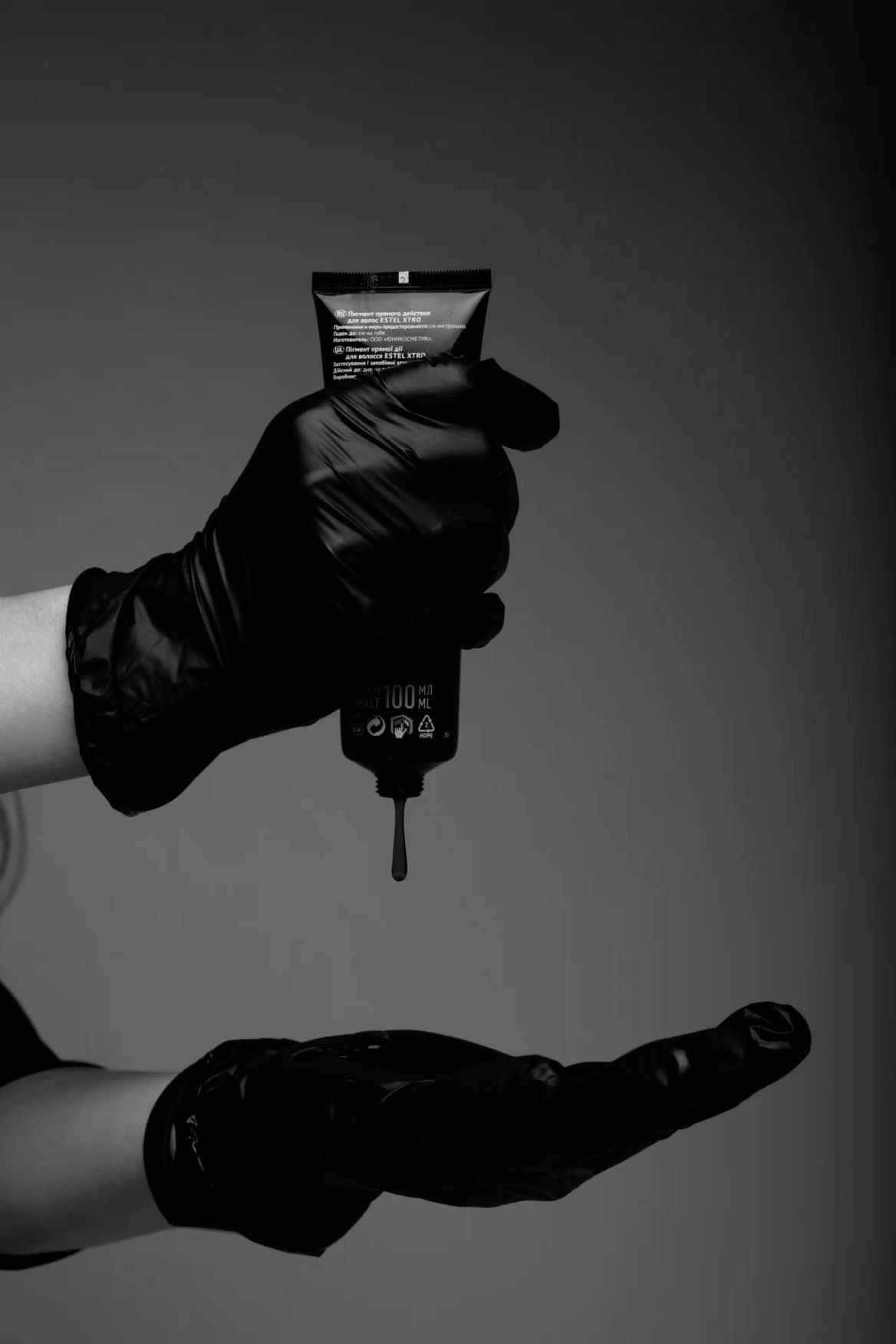
What a colour correction is
A colour correction is not a colour service, it is a repair. Artificial pigment is already in your hair and it has to be removed or worked around before anything new can go on.
That difference explains both the price and the time. An ordinary colour works on a known base, a correction works on a base that can differ centimetre by centimetre.
People usually arrive with one of four complaints: too dark, patchy, a visible band between roots and lengths, or a cast that should not be there. Each has a different cause and a different fix.
What they share is that they need a plan. Cosmetologist Samantha Goldberg puts it plainly: a correction can take three to eight hours and it is a service that stresses the hair.
So every correction starts with looking rather than mixing. What is in your hair decides what is possible, not what you saw in a photograph.
Why colour does not lift colour
This is the single most important rule in the subject: colour does not lift colour. A lighter dye over a too-dark result will not make your hair lighter.
The reason sits in the chemistry of permanent colour. Small, colourless precursors enter the hair shaft and hydrogen peroxide oxidises them into large coloured molecules.
Those molecules are too big to pass back out through the cuticle. They stay locked in the cortex, which is exactly why permanent colour is called permanent.
Put a lighter dye on top of that and you are only adding new pigment to pigment already there. The result is darker and duller, not lighter.
There are only two ways to actually remove it. A lightener that breaks the pigment down further, or a reducing agent that shrinks the molecules back down.
The four problems we correct
Nearly every correction falls into one of four categories. Recognising which one it is does half the work.
- Too dark: a colour that landed one or more shades darker than intended, usually because porous ends absorbed more pigment.
- Patchy: uneven uptake along the length, often after home colouring or over an older colour.
- Banding or hot roots: a visible band where the roots are lighter or warmer than the rest.
- Unwanted tones: green, copper or a dull cast that only appeared after rinsing.
A fifth category really belongs here too: wanting to go from black to blonde. That is not a mistake but it is the heaviest work there is, and it almost always takes several sessions.
Banding and hot roots
Hot roots happen because your head is warm. The heat of your scalp speeds the chemical reaction up at the roots, so they lift faster than the lengths.
The result is a band of lighter, warmer hair around the parting. That is not a colour choice gone wrong but a physical effect.
Other causes produce the same picture. Too strong a developer, too short a processing time, or new growth that has not fully hardened all leave a visible transition.
With home colouring the order adds to it. Starting at the roots and only then doing the lengths gives the warm zone the longest processing time, exactly the wrong way round.
The correction uses different formulas on different zones. The roots get something other than the lengths, so the end result reads as one colour rather than three.
Green and unwanted tones
Green hair is almost always a porosity problem, not a colour problem. Previously lightened hair takes cool pigment greedily, and an ash or blue-based colour hits too hard.
The fix comes from the colour wheel. Red and green sit opposite each other, so a red or copper pigment neutralises the green cast.
The same principle covers the other unwanted tones. Violet against yellow, blue against orange, and green against red when it has swung the other way.
The trap is dosage. Too much opposing colour leaves a dull, flat result, and then you have swapped one problem for another.
More on how neutralising works in the article on hair toner.
From blonde to dark and pre-pigmenting
Taking blonde hair darker looks simple and fails most often. Without pre-pigmenting the result turns greenish, muddy or simply flat.
The cause is what the lightening removed. Lifting breaks down the warm undertones first, so what remains is a base with no red or gold in it.
Put a cool or ash brown on that and it has no warmth to build on. The eye reads that as green or greyish brown, however good the colour looked on the tube.
Pre-pigmenting puts those missing warm tones back first, usually with a warm demi-permanent colour. Only then does the actual shade go on.
That turns one service into two steps. It costs extra time and it is exactly the step that separates a good colour from a correction you need a week later.
Colour removers and the risk of rebound
A colour remover is not the same as bleach. Where a lightener breaks pigment down, a remover reverses the original reaction.
It contains a sulphur-based reducing agent that splits the large dye molecules back into smaller, colourless pieces. Those are small enough to rinse away.
That is also where the risk lies. Those smaller fragments are unstable, and whatever stays in the hair can re-oxidise through airborne oxygen or through a following product containing peroxide.
In practice that means rinsing very thoroughly and not moving straight on to a peroxide product. Do that and you watch the old colour come back within days.
The advantage of a remover over bleach is that it leaves your natural pigment alone. It only takes out what was put in artificially.
The test that decides whether it is possible
Every correction should begin with an elasticity test. It takes ten seconds and decides whether any work can happen at all.
The Trichological Society describes the action like this: hold a single hair between thumb and forefinger as an anchor, and with the other hand slowly stretch the shaft to feel the drag and the recoil.
What you are looking for is recoil. Healthy wet hair can stretch about thirty percent without lasting damage, while irreversible change occurs between thirty and seventy percent and fracture around eighty.
If the hair snaps when stretched, or hangs slack without springing back, the conclusion is clear. Further chemical work is not an option, however much you want a different colour.
This test is often skipped, and that is exactly why some people arrive with hair that can no longer be saved. Ten seconds would have prevented it.
Why it takes several sessions
Almost every serious correction runs over two to four appointments. That is not a way of inflating the bill but the only way to keep your hair intact.
Peer-reviewed research shows what repeated lightening does. The cuticle scales separate and peel away, in severe cases exposing the cortex beneath with cracks running along its length.
The same research describes melanin granules dissolving and leaving voids, and the hair own lipids being reduced. Every extra round on the same day stacks that effect up.
So the gap between sessions is deliberate. At each appointment it is judged again whether your hair can take the next step, and that outcome sets the pace.
In practice a heavy correction, black to blonde for instance, quickly runs to four sessions of several hours. That is the honest expectation, not a worst case.
When cutting is the honest answer
Sometimes the right treatment is a pair of scissors. That is the sentence nobody wants to hear and that still belongs to this trade.
Salon owner Tammy Rapp says it bluntly: once it gets this bad, the only way we can help is by cutting it off. That sounds harsh but it is more honest than selling another chemical round.
The deciding moment is the elasticity test, not the client wish. Hair that snaps or will not recoil only gets worse with further treatment.
In many cases it is not all or nothing either. Often only the ends are beyond saving and the rest of the length can be corrected, which means a shorter cut but healthy hair.
How to avoid needing a correction
The cheapest colour correction is the one you never need. Four habits prevent most cases.
- Always say what has been in your hair before, even years ago. Old colour decides how new colour takes.
- Do not move more than two shades at a time, lighter or darker.
- Do not put a home colour over an earlier colour without knowing what is underneath.
- When in doubt, test a strand first rather than the whole head.
The most expensive mistake is a box colour over bleached hair. That combines an unknown formula with a porous base, which is precisely the recipe for patches.
What a colour correction costs
With Hanna Valiullina a colour correction starts at two hundred euro, home visit included. Lightening the regrowth with toning starts at a hundred and twenty euro.
Because several sessions are usually needed, you get an estimate for the whole job in advance and not just for the first appointment. That is the only honest way to quote this.
The price moves with hair length, density and how much artificial pigment is present. A correction on long, repeatedly coloured hair takes more time than on short hair with one layer of colour.
Compare it with an ordinary colour appointment and the value of prevention becomes obvious. A root touch up starts at fifty euro and colouring the lengths at seventy.
Colour correction at your home
Hanna Valiullina does colour corrections at your home in Papendrecht and the surrounding area. For this service, do count on half a day per session.
Every correction starts with an assessment in daylight and an elasticity test. From that comes a plan with the number of sessions, and you hear it before anything is mixed.
What I will not do is promise a one-visit fix when there is not one. An honest estimate beforehand beats hair that breaks halfway through.
More on how colour works under hair colouring and bleaching hair. All rates are under services, and for advice with no obligation you can get in touch.
Frequently asked questions about colour correction
What is a colour correction?
A colour correction is putting right a colour service that went wrong: too dark, patchy, banded or carrying an unwanted cast. It is not an ordinary colour appointment but a plan that often runs over several sessions.
Why can a too-dark colour not be fixed with a lighter dye?
Because colour does not lift colour. In permanent colour the dyes form large molecules that become trapped inside the hair shaft, and a new dye only adds pigment rather than removing it.
Why are my roots a different colour from my lengths?
That is called banding, or hot roots. The warmth of your scalp speeds the reaction up at the roots, so they lift faster and lighter than the rest of your hair.
Why did my hair turn green after colouring?
An ash or blue-based colour on porous, previously lightened hair grabs too much cool pigment. Green is neutralised with red or copper, because they sit opposite each other on the colour wheel.
How many sessions does a colour correction take?
Two to four, depending on how much artificial pigment is present and what your hair can take. There is time between sessions, because the condition of your hair is reassessed each time.
Can any hair be corrected?
No. If a wet hair snaps when stretched or stays stretched without recoiling, further chemical work is a bad idea and cutting is the honest answer.
Can a colour remover take my old colour out?
A colour remover uses a reducing agent that shrinks the dye molecules back down so they can rinse out. The risk is that residues re-oxidise and the colour darkens again after a few days.
What does a colour correction cost?
With Hanna Valiullina a colour correction starts at two hundred euro, home visit included. Because several sessions are usually needed, you get an estimate for the whole job beforehand.
The essentials
Colour does not lift colour: a lighter dye over a too-dark result only makes it darker. Only a lightener or a reducing agent removes artificial pigment.
Banding comes from the warmth of your scalp, green from porous hair grabbing too much cool pigment, and muddy dark from a missing pre-pigmentation. Each needs a different approach.
A correction usually takes two to four sessions with time in between. And if the elasticity test comes out badly, cutting is the honest answer rather than another chemical round.