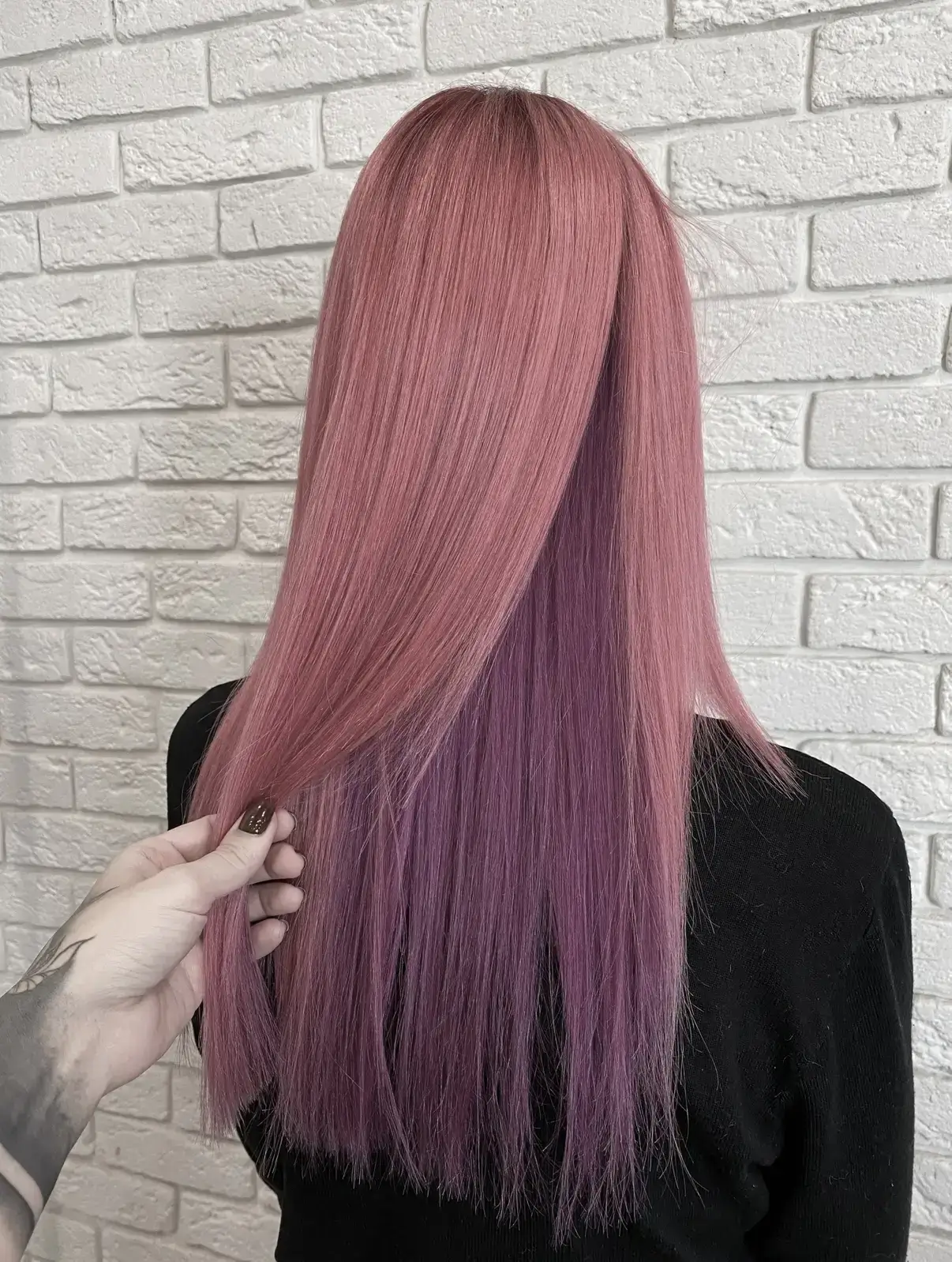
What ombre hair is
Ombre is a colour gradient in two zones. The top stays dark, the bottom goes lighter, and between them sits a transition that runs horizontally across the full width.
That horizontal quality is the defining feature. Where other techniques pick out individual pieces, ombre treats everything at a given height the same way.
The result is a clearly visible gradient rather than a subtle blend. That is not a weakness but the point: ombre is meant to be seen.
To be clear, this article is about hair. The word ombre is also used for an eyebrow technique, and that is an entirely different trade.
Where the word comes from
Ombre comes from French and literally means shaded. It is the past participle of ombrer, to shade, which traces back through the Italian ombrare to covering something in shadow in painting.
So the word long predates its use for hair. In English it is recorded from around 1840, and in textiles the technique was applied earlier still.
There is a printed wedding dress from 1841, for instance, in which the fabric is dyed in a graduated rainbow. Embroidery thread was already being dyed in gradual colour transitions in the nineteenth century as well.
Exactly when ombre broke through as a hair trend is harder to pin down. What is certain is that by around 2013 the word was common enough for newspapers to call it ubiquitous; the stories crediting a single artist with starting it are not well supported.
Ombre, balayage, sombre and bronde
Four words used interchangeably, while only two of them are genuine techniques. The distinction is worth having.
Ombre
A horizontal gradient from dark to light, where at each height the full width is treated the same. Clear contrast, clear transition.
Balayage
Freehand painted pieces, generally without foil, running vertically and placing most of the light at the surface and around the face. More natural and scattered than ombre, and often dearer because it is more handwork.
Sombre
Not a separate technique but a softer execution of ombre, with less contrast and a more gradual transition. Anyone who finds ombre too pronounced ends up here.
Bronde
Not a technique at all but a colour: a blend of brunette and blonde for the shade in between. You can reach bronde with ombre, with balayage or with an all-over colour.
Dip dye belongs in this list as a variant of ombre, usually when the ends are taken into a pronounced fashion shade rather than a natural one. The distinction is more linguistic than technical.
How the technique is applied
The craft lies not in the lifting but in the transition. A hard line between dark and light is the difference between a good ombre and something that looks like a mistake.
The colourist first decides where the transition will sit. That point governs the whole result, and it is matched to your length and to where your hair moves most.
The lower zone is then saturated with lightener and the transition zone is softened, so a gradual gradient forms instead of a stripe. That softening is the real handwork.
Chemically the same thing happens as in any lightening service. Pigment is broken down, the warm undertones appear, and those are corrected afterwards with a toner.
Count on around three hours for a full service. On long or thick hair it runs longer, because the saturated zone is bigger.
Which hair type and length it suits
Ombre needs length, and that is the main condition. A gradient has to have somewhere to happen.
On mid-length to long hair there is enough room between the dark zone and the ends for the transition to work. On a short cut that room disappears and little is left that reads as a gradient.
On curly hair ombre works surprisingly well, because curls catch light irregularly anyway and the transition softens by itself. The transition is usually placed a little higher on curls.
The main limitation is the condition of your ends. Since that is exactly where the hair is lifted furthest, damaged or very porous hair is not a good candidate.
How much contrast to choose
Contrast is the dial everything hangs on. The same principle gives a subtle or a pronounced result purely depending on how many shades of difference you keep.
- Low contrast, two shades apart: reads as sombre, natural and low maintenance.
- Medium contrast, three to four shades: the classic ombre effect with a visible but soft transition.
- High contrast, five shades or more: pronounced and fashionable, but it demands lifting the ends furthest.
- A fashion shade in the ends: that is effectively a dip dye, and then the lightening decides how clean the colour lands.
On dark hair the temptation is to go all in. Bear in mind that every extra shade of contrast means the ends are lifted further, with everything that implies for condition.
Regrowth and upkeep
This is the big advantage of ombre: there is no hard regrowth line. Your roots keep your own colour, so new growth simply extends the dark zone.
That lets you wait months without looking unkempt. In practice people come back after roughly two to three months, and often only to refresh the tone.
Compare that with an all-over colour, where the roots show after four to six weeks. That difference is why ombre has a reputation for low upkeep.
What does shift is the position of the transition. As your hair grows the gradient travels down with it, and at some point you want it back up.
The ends take the hit
With ombre the heaviest load lands on the part of your hair least able to handle it. That is the honest downside of this technique.
Your ends are the oldest hair on your head. They have the most washes, the most heat and the most sun behind them and are already more porous than the rest.
That is precisely where ombre lifts furthest, and across the full width rather than in scattered pieces. It makes the load per centimetre greater than with balayage.
The practical consequence is that the ends need trimming more often. An ombre that still looks good after six months is usually one whose ends have been tidied along the way.
Toner and colour retention
The toner follows the lifting and decides whether your result reads cool or warm. Without that step the yellow or orange tones released during lightening stay visible.
The toner fades before the gradient does. That is also why people come back: not because the ombre has grown out, but because the tone has shifted.
In between, purple shampoo keeps the warmth in check. Do not use it at every wash, since too much violet pigment leaves a lilac or dull cast.
More on how neutralising works in the article on hair toner.
Care after the service
All the care here goes to the lower half. That is where the lightened hair sits and where the damage collects.
Wait at least forty eight hours before washing and rinse with lukewarm water afterwards. Hot water opens the cuticle and lets pigment escape.
A weekly mask on the lengths and ends keeps things supple. The roots do not need it, since they are untreated.
Limit heat on the ends and always use heat protection. Porous hair reacts more strongly to a straightener than untreated hair, and with ombre that is exactly the part you style most.
More on daily routines under hair care.
What ombre costs
With Hanna Valiullina a complex colour service such as ombre, balayage or shatush starts at a hundred and eighty euro, home visit included. A fine balayage starts at a hundred and thirty.
The price moves with your hair length and density, since those decide product use and time. On very long hair you hear the difference beforehand.
Budget two to four appointments a year, most of which are toning only. That makes ombre cheaper across the year than an all-over colour needing a touch up every five weeks.
Ombre at your home
Hanna Valiullina does ombre at your home in Papendrecht and the surrounding area, with professional products. You need a chair, a socket and a tap.
With a gradient, daylight matters a lot. You judge the transition in the light you wear your hair in every day, not under salon lighting that makes the contrast look softer than it is.
If you are torn between ombre and something softer, look at balayage or airtouch. All rates are under services.
For an appointment or advice on what your ends can take, get in touch.
Frequently asked questions about ombre
What is ombre hair?
Ombre is a two-zone colour gradient: the roots and upper section stay dark while the lengths get gradually lighter towards the ends. The transition runs horizontally across the full width of your hair.
What is the difference between ombre and balayage?
Ombre is a horizontal gradient from dark to light across the whole width, balayage consists of freehand painted pieces running vertically. Balayage therefore reads as more natural and scattered, ombre gives a clearer and more deliberate effect.
What is sombre and is it different?
Sombre is the same technique with less contrast and a softer, more gradual transition. It is not a different mechanism but a subtler execution of the same idea.
Is bronde a colouring technique?
No, bronde is a colour rather than a technique. The word blends brunette and blonde and describes a shade in between, which you can reach with ombre, balayage or an all-over colour.
How often does ombre need refreshing?
Because the roots keep your own colour there is no hard regrowth line, so you can wait months. In practice people return after about two to three months, usually for the toner rather than the gradient itself.
Does ombre work on short hair?
Poorly. A gradient needs vertical room to become visible, and on a short cut there is simply not enough length between the dark zone and the ends.
Does ombre damage your hair?
The ends take the hit, because that is where the hair is lifted furthest. That is exactly the part that is already oldest and most porous, so aftercare is not optional with this technique.
What does ombre hair cost?
With Hanna Valiullina a complex colour service such as ombre, balayage or shatush starts at a hundred and eighty euro, home visit included. The final price depends on your hair length and density.
The essentials
Ombre is a horizontal gradient from dark to light across the full width of your hair. Balayage is something else: freehand painted pieces running vertically.
Because your roots keep your own colour there is no hard regrowth line and you can wait months. What returns sooner is the warmth, and that is what the toner is for.
The downside sits in the ends, since that is where the lifting goes furthest on the oldest hair. Trimming and a weekly mask are not optional with this technique.