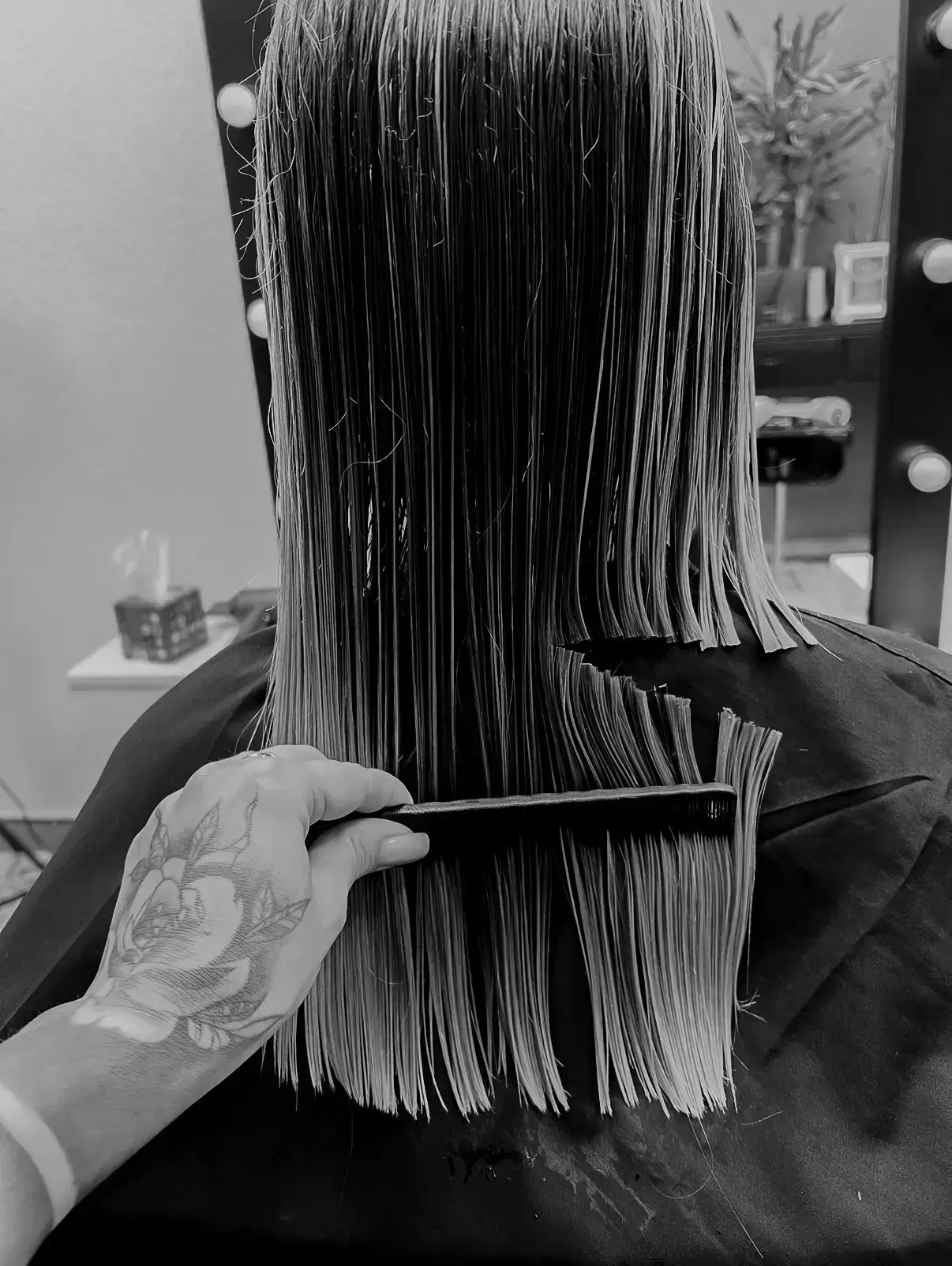
Cutting versus styling
A cut sets the shape, styling sets the day. That distinction sounds small and explains almost every disappointment with a new haircut.
The cut fixes how your hair falls the moment you leave it alone. That shape stays for weeks and only changes because the hair grows.
Styling is the temporary layer on top: drying, curling, smoothing, lift at the roots. It is gone at the next wash.
Anyone who sees something in the mirror that never reappears at home is looking at styling, not at the cut. The honest question is whether the result lives in the scissors or in the dryer.
A good stylist asks that before the scissors appear. The treatment you book should match the answer.
How a cutting and styling appointment runs
The order never changes: consultation, wash, cut, style. Each step has a reason and the first one matters most.
My consultation takes five to ten minutes and is about what you actually do with your hair, not about what you should be doing. How much time you give it in the morning shapes the cut more than any photograph.
The hair is then washed and towel dried, and cutting starts at the back. Working back to front keeps the length relationships honest.
Styling comes last and doubles as the demonstration. You see how the cut is meant to sit and which movement brings it back at home.
Washing is part of the treatment
Washing is technique, not a courtesy. Damp hair falls evenly and the scissors travel through it cleanly.
Yesterday's styling also falsifies the picture. Hairspray residue and dry shampoo hold sections in places they would never sit on their own.
The wash itself should not be rough. Fingertips on the scalp rather than nails, and lukewarm water instead of hot.
If you have just come from the gym or the pool, say so. Chlorine and salt stiffen the hair and that changes how it needs to be cut.
Wet cutting or dry cutting
A wet cut gives the sharpest line, a dry cut gives the most honest shape. Both belong to the craft and your hair decides which one applies.
Wet hair hangs longer than dry hair and springs back as it dries. On fine straight hair that is predictable, so a wet cut works well for a blunt bob or a level line.
Curly hair distorts the most when wet. A curl that looks five centimetres longer wet will jump back exactly that far, and that is where regrettably short fringes come from.
So I prefer to cut curls dry, curl by curl. You see immediately where the length actually lands.
On thick hair that expands, a combination works best: the base shape wet, the correction dry. There is more on this in the article about haircuts.
Cutting techniques and what they do to your shape
A cutting technique is not a style but a tool for a problem. Knowing the four basic movements explains why your hair behaves the way it does.
Blunt cutting for weight
The scissors sit square to the section and the line comes out hard. That builds density at the bottom and is the foundation of every bob.
Point cutting for softness
The scissors sit at an angle into the section, breaking the line so it reads softer. Point cutting is also the only real fix for split ends. Products close a split temporarily at best, cutting removes it.
Thinning for volume you do not want
Thinning shears remove weight without changing length. On fine hair this is risky, since thinning there produces frizz rather than calm.
Layering for movement
Shorter sections above longer ones create movement and lift. The angle at which the section is held decides how visible the layer will be.
Your hair type sets what the cut can do
The same haircut lands four different ways on four heads. That is physics, not bad luck.
Thickness, density and curl pattern are three separate properties. You can have sparse hair made of thick fibres, or abundant hair made of fine ones, and those two ask for opposite cuts.
Fine hair gains from a compact line and loses from too much layering. Thick hair gains from internal layers that remove weight without touching the outline.
A double crown or a strong growth direction at the hairline decides where a parting belongs. You can cut against it, but rarely with lasting success.
Layers, length and volume
Layers are the most overused fix in the trade. They give movement to hair that hangs too heavy and strip strength from hair that is already thin.
Long hair without layers hangs like a curtain and reads as heavy. A few long layers from chin level break that without sacrificing length.
On mid length hair the gain sits around the face. Shorter sections there steer the eye, which is the subject of the article on face framing.
Volume rarely comes from a product and usually from the roots. Drying the hair away from its natural fall does more than any mousse.
Styling by the hairdresser and styling yourself
The styling the hairdresser does is a demonstration, not a promise. What you get at home depends on the movement you take over.
Blow drying starts once the hair is mostly dry, not soaking wet. Until then the dryer is evaporating water, not shaping anything.
Direction matters more than heat. Shine comes from a smooth cuticle surface, and drying smoothly in the direction of the shaft helps achieve it.
Let each section cool before you release it. Hair takes its shape as it cools, and that is the step most often skipped at home.
Ask your stylist to demonstrate the movement with your own dryer. Advice about a brush you do not own is advice you cannot use.
The products you actually need
Three products cover almost every style. The rest of the shelf solves a problem you probably do not have.
- A heat protectant, always, before any dryer or iron comes near.
- Something that gives grip: mousse for root volume, salt spray for texture, or a light cream for smoothness.
- A hairspray you can brush out, so the style does not turn into a helmet.
More product does not give a better style, only heavier hair. On fine hair half a pump of mousse is often already too much.
Apply styling products to damp hair and spread them with your hands rather than a brush. Product that lands on dry hair stays exactly where it fell.
Dry shampoo is maintenance between washes, not a replacement for them. Built up dry shampoo leaves the scalp dry and the hair dull.
Heat is the limit of every style
Every heated style costs something. The question is not whether you take damage but how much you will pay for today's shape.
Work as cool as the result allows, not as hot as the tool permits. The highest setting on a straightener is meant for the coarsest hair, not for your fine lengths.
Never put an iron on wet or damp hair. Water trapped in the shaft turns to steam and blows the fibre apart from the inside, damage dermatologists know as bubble hair.
A heat protectant moves the problem rather than removing it. It slows the heat transfer, which helps, and that is all.
The American Academy of Dermatology keeps it simple: flat irons on dry hair only, on a low or medium setting, and no more often than every other day.
Daily styling shows up in the ends within months. Building in more heat free days does more for your hair than the most expensive mask.
How often to cut and style
Scalp hair grows roughly one centimetre a month on average. Almost every cutting interval in the trade follows from that single number.
A short cut loses its shape fastest, because a centimetre is immediately visible. Expect four to six weeks.
Mid length and long hair holds longer and needs maintenance on the ends rather than on the shape. Eight to twelve weeks is the norm there.
If you are growing your hair out, cutting stays necessary, just less often and less deep. Cutting does not speed growth, but it stops split ends travelling up and costing you the length anyway.
Styling has no interval. You book that when the occasion asks for it.
What to discuss beforehand
Five minutes of consultation saves three months of regret. Take the conversation more seriously than the photo on your phone.
- How much time you genuinely spend on your hair in the morning, measured honestly.
- What annoys you about your current cut, since that steers better than what you like.
- Whether your hair is chemically treated, and when that was last done.
- Which styling tools you own and which ones you actually use.
- When you want to come back, so the cut is built around that interval.
A photo helps, but say what you see in it. Two people choose the same picture for opposite reasons.
More questions worth raising are in the article about questions to ask your hairdresser.
What cutting and styling costs
With Hanna Valiullina a women's cut starts at twenty five euros and a men's cut is twenty five euros. A children's cut starts at fifteen euros.
Trimming the ends is thirty euros and a wash with a trim is thirty five euros. An evening style with washing, styling and curls starts at forty five euros.
Those figures include the visit to your home inside the working area. There is no separate call out fee.
The full list of treatments and prices is on the services page.
Cutting and styling at home
Cutting at home has one advantage a salon cannot sell: you judge the result in the light you actually live in. Salon lighting flatters and daylight does not.
You need very little. A chair without armrests, a socket, a tap and your own clean towel.
The rest travels with me: scissors, combs, clips, dryer, cape and covers. I work in Papendrecht and the surrounding towns, evenings included.
For occasion styling your own home is often the more practical choice, since you never have to walk into the wind afterwards. To book or to talk it through first, get in touch.
Frequently asked questions about cutting and styling
What is the difference between cutting and styling?
A cut sets the shape your hair has the moment you stop touching it, styling decides how that shape looks today. The cut lasts months, the styling lasts until your next wash.
Will my hair be washed before it is cut?
Usually yes, because clean damp hair falls evenly and the scissors move through it cleanly. A dry cut on curly hair is the exception, since every curl needs to show its own length.
What does cutting and styling at home cost?
With Hanna Valiullina a women's cut starts at twenty five euros and a men's cut is twenty five euros. Trimming the ends is thirty euros, a wash with a trim is thirty five euros, and an evening style with washing, styling and curls starts at forty five euros.
Is a wet cut better than a dry cut?
Neither is better, they do different jobs. A wet cut gives the cleanest line, a dry cut shows you how the hair actually behaves, which matters more on curls and on heavy volume.
How often should I have my hair cut and styled?
A short cut loses its shape after roughly four to six weeks, mid length and long hair holds for eight to twelve. Styling is not maintenance but a choice, usually for a wedding, a party or a photograph.
Which styling products do I really need at home?
Three cover almost everyone: a heat protectant, something that gives grip such as mousse or salt spray, and a light hairspray to hold it. The rest is preference, not necessity.
Can I recreate the salon styling at home?
If the cut is right, yes, and that is exactly what a good cut should be judged on. Ask during the appointment to have the drying movement demonstrated, because you cannot read it off the finished result.
Can a mobile hairdresser also do styling?
Yes, and for occasion hair your own home is often more practical than a salon. You are already where you get ready and you do not have to walk into the wind afterwards.
The essentials
Cutting sets the shape, styling decides how that shape reads today. Judge a haircut only after your first wash at home.
Let the technique follow your hair type rather than the photograph. Fine hair gains from a compact line, thick hair from internal layers.
Work cooler than the tool allows and never apply an iron to wet or damp hair. Two heat free days a week are worth more than an expensive mask.